Showing posts with label lifelong learning. Show all posts

Friday, 10 May 2019

#Blockchain in #learning exploring for #validation of lifelonglearning #certification

This is the first part of a series on Blockchain for Learning posts. In this post I am giving my (current) overview of Blockchain options from industry, a second post will focus more on the academic side (including impact on universities), and I will add a philosophical post on it as well).

Background and project
As I am working on the learning bit of the skills 3.0 project (a multi-disciplinary project combining AI, HR, learning and learning certification, see basic slides here), I have been gathering some Blockchain-for-Learning solutions as well (exploring options before adding them to the project slides). 

Main idea for using Blockchain (open or closed) for learning
What I am looking for is a stackable certification solution, which blockchain for learning or education can provide. This stackable way of organising or linking learning could enable a validated, personalized certification procedure covering both formal learning (e.g. certification, degrees, micro-credits) and informal learning (e.g. badges, skills, experiences). Practically: each learner has a learning wallet or portfolio, and you - as a learner - can add each learning step as you 'earn' it and you are issued a certificate/badge of what you learned by a learning authority/individual/group).  

Why is this useful?
Remember how each one of us has to give proof of learning whenever we want to change jobs, or when HR sets up these profiles that are so complex, that you wonder whether you will ever fit in? Well, in an ideal world this blockchain-for-learning solution might shed some light on both your formal credits, as well as your experiences throughout life and even your emerging interests (e.g. blockchain basics). It is a bit like a LifeLongLearning Accreditation On Steroids. 
So the blocks of this blockchain would be all instances where you learn, this could be study hours, but also workshops, reading, interactions with experts, papers, patents, peer groups of practitioners ... 
The idea is to support personalized learning when people are reskilling or upskilling their competencies and knowledge and adding a layer to it so their training and learning can be certified in a secure and digital fashion. 

Its technology, so there are heated debates
With all new technology, the heated debates emerge as well: what is the best, what are the upsides, who is a true believer, who is a true cynic... all of this I keep for a post later on this month. For now, just to give an idea, I am focusing on what is out there. Which is more than I had imagined. 

Blockchain you say? 
Any transaction between different parties where the transactions need to be validated, and they are distributed across locations fit the blockchain technology. The data is distributed over a massive amount of people, which would make tracking all the transactions very complex if done manually. Blockchain automates these transactions, and in many cases, they use distributed databases, as well as smart contracts to enable transactions. A smart contract is a computer protocol intended to digitally facilitate, verify, or enforce the negotiation or performance of a contract. Smart contracts allow the performance of credible transactions without third parties. These transactions are trackable and irreversible (it being irreversible is one of the topics of debate, for instance, even if you are the author, you cannot change the transaction... so how does this fit in with Personal Data?). However, there is one important factor: the learner should be the one in charge of who can see what from his 'learning experiences and certification', which means she can give or revoke access to personal records. 

A great white paper on it (53 pages), called My Skills Project, written by John Casey from City of Glasgow College is a good read to get acquinted with blockchain for learning, focusing on vocational training (great read!). 

Some features that I feel are key:
  • Privacy (well, yes)
  • Learner is the owner of all data (others might be as well, but intermittent, while the learner is the owner of all their data. Right to be forgotten is also important, but seems difficult at this point - says my colleague Frederik who knows more about blockchain tech).
  • mobile first (you would think this is a given, but ... it still is not).
  • Standardization (otherwise it becomes difficult to achieve lifelong learning traceability)
  • Bridging formal and informal: this demands a variety of validated certification, including micro-credits, open badges and the like.
Giving some examples of products out there or in progress
Chainscript demo by Phil Komarny (Chainscript from SalesForce): in just 5 minutes Phil gives an overview and live (!) demo of the chainscript on mobile (oh yes!).

SmartDegrees: a mobile tool developed in Spain (the app already exists and has been rolled out in some Spanish Universities, a.o. Carlos III in Madrid). Because this solution seems (at least) a good starting point, I have a meeting with one of its people next week (looks promising, you can see a 2-minute video of what smartDegrees does here, but only in Spanish at the moment). 

A great comprehensive overview of Blockchain overall and with practical implementations in education comes from the Open University (UK), which looks at their plans for smart contracts, micro-accreditation, open badges, ... great 9-minute video. It is John Domingue (director of KMI at the OU) who speaks, and he has just been awarded the fellowship of the British Blockchain Association. 

LearningMachine: from MIT lab, and the good old W3C credentials community group, LearningMachine emerged. This is a full product in market, fully self-sovereign identity. But not sure how open they are to non-classic accreditation, although their video does include 'skills equivalencies' but not sure of the peer recommendations or fully informal learning options. They seem to be more focused on formal education (from government, university, companies). Their 2-minute mobile app can be seen in action here.

Standard-oriented information
CIMEA is the Italian Blockchain for qualifications standard. Their certification wallet service is called Diplo Me, which is still under construction.

DigiCerts is the German counterpart for Blockchain certification standards.

Blockcerts, subtitled "the open standard for blockchain certificates" is a service connected to Learning Machine, and also works towards a standard in an Alliance of major universities (which makes it feel mostly formal in certification). 

Europe is developing a standard embedded in its Digital Education Action Plan, called "framework for digitally-signed credentials". (pdf-document) A mostly theoretical approach, but of interest as it will be linked to Europass and such.

And of course the laudable Open Badges, used by multiple organisations (e.g. The Open University) to certify informal learning (I love this one, but it is of course going against the dominant system).

Some additional sources
Accredible is another, with UK, Netherlands and USA offices. They work across LMS systems, so they seem more LMS oriented. A lot of reading to get the idea, but nice reading. This is more like a certification publisher, not an active certification wallet option. 

The American, Public University system has blockchain lined up as well, but I could not find a bigger description of their project. 

Blockchain is a hot topic, so there is a multitude of courses out there, but one that seems to specialize is the Blockchain Training Alliance . They do not seem to offer specific Blockchain products though.

There are also some standards being developed (nice to keep in mind when wanting to use blockchain in a later stage):


Then there are a couple of blockchain companies who haven't developed a Blockchain for learning solution, but seem to be eager to explore the field:
T-mining (Belgium) - working with Frederik to explore which solution would fit my need best, great people to talk to. 
Learnovate (Ireland, connected to Trinity College Dublin), wrote a piece about it here.

Looking forward to getting a more in-depth look at these, and considering some of the more academic and philosophic ideas paralleling this technology. If you know of any other solutions, feel free to add them as a comment, or let me know. 

(picture from OpenBlockChain from UK)

Tuesday, 19 February 2019

Just sharing a few rejections: paper & funding, and solutions #academicLife #life #loveMyNetwork


Life can be hard, both personally and professionally, yet at the same time life can simply push you towards a more pleasant option along the way, seemingly using rejections to get you on to the right track. I sure hope this will be the case, but only hindsight will tell. [addition one day after writing this post: while sharing these ideas on Facebook, I got such an inspiring response from my network, I decided to add the ideas and remarks they had below, between square brackets]
Today I was informed that my co-authored paper for the eMOOC summit 2019 in Naples was rejected. Rejections rarely result in joy, and this was no exception. For some reason writing a paper is also a personal effort. You try with all your ability (and mostly under a bit of time pressure) to come up with a paper that shares your research in just a few pages. Referencing to prior great minds in your field of expertise. So, when a paper gets rejected, it simply hurts. It feels personal to some extent.
The rejection came one week after my submission to get a prestigious Marie Curie Fellowship got rejected as well, it did not get the threshold. The review did have a lot of positive points though (which did soften the blow). Granted, I wrote this submission as a plan B in order to increase my options to get back to work after I recovered from the year rehab after the cancer diagnosis. I put my heart into it, not only me but also the professor who was willing to employ me in his department if the fellowship was successful. Luckily, I was able to get back to work and on good terms, and on an inspiring project.
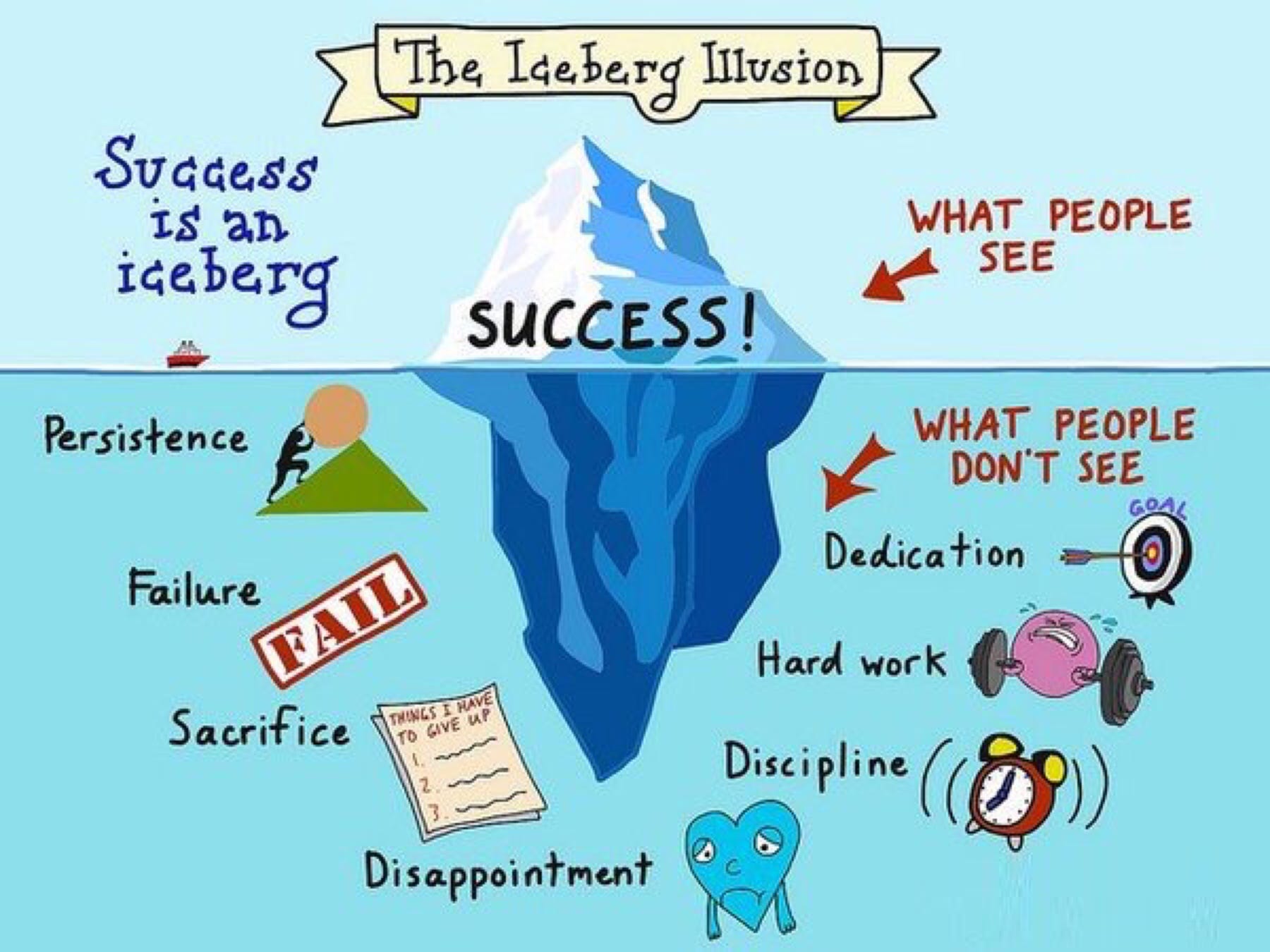
[It seems that rejections are common to everyone, even the highest esteemed scholars get them despite their obvious wisdom and knowledge. My friends shared some good advice and resources that help to bounce back from rejection. First off: upward and onward, as simple as it sounds, it works ... once you have managed to soften the feeling of a work being rejected. The process is to reflect, look at the feedback (or if they did not send any, ask for all the feedback, of course, anonymized), and rewrite and resubmit. Next, a great article in Medium on The Iceberg Illusion, adding the picture here as well.]

But the above two rejections just made me realize once more that I am not a traditional academic and as such, I doubt whether I can ever be part of the whole deal. Maybe this frequency of rejection is simply normal, but at present, I just feel I need to take another leap. Just like I did three times before. Maybe I am not made to gradually move forward? Maybe my thing is just this .... jumping ahead and then working on that 'new' concept until it becomes more mainstream.
[Feedback is an essential first step, next of course is to get going and to know thy self. And to repeat to yourself that critique is not personal, and it can be based on a number of reasons that do not even have to be immediately related to the work you did. In a way, emotion wins over ratio every time, but that does not mean we cannot rationalize after the first emotions have gone.]
Ciska sometimes tells me: "don't wine because you are living off the beaten track, even if you could walk the straight and narrow, you still would roll out your own route to get to the next place". Maybe she is right, but it does not make things easier. Maybe, it is never easy for any of us. Even for those who walk the more traditional roads to achieve a professional space in society. I don't know, but each time I get such a rejection, I just feel it's because of me, and it feels personal.
Okay, time to move forward again. Working on a project which combines human resources, AI and learning... fun, I must admit.
[and this is - and has always been - an inspiring Last Lecture]


Cartoon in this blogpost is from the fabulous Nick D. Kim - the http://www.lab-initio.com/ site

Tuesday, 25 April 2017

Liveblog from university to continued professional learning #educon17 #lifelonglearning

Frank Gielen talks on innovation adoption and transformation. This talk is part of the pre-conference talks of the Educon conferencein Athens, Greece. The talk looks at how to organise learning (master, professional, phd…) to gradually move towards lifelong learning.

Skills gap between what the companies want and which human resources and innovations are available.
The human capital is missing frequently, which means that education is increasingly important.
If you want to transform your ‘old’ energy approach to sustainable or renewable energy approach(es).
So education is core in the innovation process, as you need to train all stakeholders (senior management, workforce on the floor, mid-management…).
Education linked to innovation has two main factors impacting it: speed of adoption (graduates need to be skilled), timeliness (skills need to be used within 2 months at least).
So innovation speed is equivalent with training need. Learning needs to be adapted to speed of innovation.

Personalising learning
Starting from the knowledge triangle: education, industry and research as a baseline for higher education goals which needs to be combined in order to create an employable highly trained workforce coming out of higher ed.
What learning trends are important to stay competitive in the market: Continued Professional Development, become power learners. This means that the human factor needs to be continually developing, in order to be on top of a high turn-around field.
No one size fits all, so in education this means personalised learning, the role of the teacher changes that instead of having a lot of lectures, having online resources which students are knowledgeable to use to create a constant base-line, adding mentoring e.g. the Socratic approach where the teachers are in close contact and support learners.
Solving a challenge also includes having an effect on society.

Merging masters with professional learning
Contemporary learning consists on average of: 70 percent informal learning, 20 percent social learning, 10 percent formal training.
MicroMasters (short online format 10-15 ECTS and commonly project based), in many cases complimentary for the campus teaching, but enabling a blended master. This is something we need to consider as InnoEnergy. But in many cases microMasters are linked to deepening learning in a specific field, and is frequently based on a general foundation (so need for clear learning paths). 
We are shifting towards lifelong learning, blurring the boundaries between master schools, doctoral schools and professional schools.
Learning architecture: MOOCs or microMaster, certified microMaster, blended microMaster with coaching, blended-in-house microMaster with coaching and Bring Your Own Program (BYOP).
A new learning paradigm: personalised, just-in-time learning.
Education is going through a digital transformation. This means that more data is available, which we can start using as a means to support learning. Based on this personalised learning will become available, and lacking skill sets can be found. Data driven education comes a bit closer to enabling personalised learning.
Feedback and coaching has the highest learning impact. This means that teachers need to be prepared to become a guide-on-the-side or a good coach.

Learning entrepreneurship
Learners need to learn it. But not all of the students need to be entrepreneurs, but all of the students need to understand an entrepreneurial skill set: see opportunities, motivate people, drive change, find scarce resources, deal with the uncertainty of innovation. But … then how we measure this, and assess it?

This means being an early adopter, and being a catalyst for educational innovation.

Friday, 13 May 2016

Future of Education: merging quantified, qualified & connected Self #telepathy #telekinesis #quantifiedself

The people from the European Multiple MOOC Aggregator (EMMA) asked me to contribute my view on the Future of Education. So I recorded a talking head video (added below the slide deck), and accompanied it with a slide deck. In this This video proposes the Future of Education as the realization of human telekinesis and telepathy as a result of merging the quantified, qualified, and connected self. By reaching a telekinetic and telepathic state of mind, more time is left to dedicate to each of our personal learning goals. But in order to reach this connected state we must provide more curated content (like MOOCs), achieve a better understanding of how the mind works, and promote open access and open data. The video also offers two possible assignments.


Future of education for EMMA MOOC from Inge de Waard

And here is the full video:

Monday, 21 March 2016

Self-regulated learning for measuring motivation & self-esteem in #MOOC #motivation #SRL

For those interested in self-regulated learning, building upon the knowledge which is created over the years, I gladly share a recently published paper, which is part of the eMOOCs2016 proceedings. The project is briefly explained, and in this paper we (the authors) also refer to the self-regulated learning instrument which is used to monitor young students (16-17 year old) while they follow MOOCs to enhance their personal interests. The goal of this project is to increase (online) lifelong learning skills. The paper includes a reference to a SAM-scale for attitude and skills measurement, focusing on language skills (i.e. practical use of language: speaking, listening), and digital skills such as critical thinking.
The paper gives an update on a year long project which runs at GUSCO, a large and innovative secondary school in Kortrijk, Belgium, for which I lead the research end of the project (in participative mode with the teachers and directors).
The paper can be seen as part of the conference proceedings here, or downloaded from Academia here, the paper is entitled; "Ensuring Self-Regulated Learning outcomes in a MOOC and CLIL (Content and Language Integrated Learning) in a k12 project. 

Wednesday, 9 March 2016

Keynote: non-native English speaking k12 students using MOOCs #MOOC #digitalskills

In January I had the pleasure of being invited to the Institute of Technology in Sligo, Ireland to share my findings on a project which involves high school students using MOOC to increase their digital skills, as well as their practical language skills. This is a project which is running until June 2016, and which spans one academic year. The students are 16 - 17 year olds, and I have been given updates on the project as it evolves. But thanks to the wonderful people at ITSligo, I can also share the keynote on this ongoing project.

In the meantime I did interviews with the students at mid-course. The students have now completed their Group MOOC (having gone through a MOOC they choose in groups of 2 or 3), and are ready to commence the MOOC of their own choice, and engage in it autonomously. The outcomes keep surprising me, as the students clearly pick-up digital skills, increase their digital literacies as they use and take in different media types, and all of this in a non-native language. But  more on the project later. Here is the keynote speech, with slides, and some Q/A. 

Tuesday, 1 December 2015

#OEB15 MOOCs in Schools adding a lifelong learning experience #OPN19

On Thursday 3 December 2015 during Online Educa Berlin, Kathy Demeulenaere, Heidi Steegen and myself will be leading a session looking into MOOC and how they can be used in secondary schools (high schools, K12) to enhance lifelong learning skills and put more students on route to find their own meaningful, professional life. The session is an open session, where we will start off with our own project. In brief, our project is about supporting 16 - 17 year old students to start learning with MOOCs, and then letting them choose the MOOC they want to follow, in a non-native language, specifically in French or English).

This means that teachers need to let go: they are guides, no longer teachers; and it means that students need to enhance critical thinking and autonomous learning, which can be quite scary. But while doing this, and might I add that the three teachers who are leading this project obtain amazing results (looking at self-esteem and motivation of students). But there are also many challenges, as well as new opportunities that might be good to find answers too or to explore. In this session we want to look for answers to these challenges (maybe we can find answers in the experiences from participants in the session), and also explore options that might help in getting these lifelong learning skills somehow manifested or strengthened by educational technologies.

So feel free to join this session (it is planned for 90 minutes, with our project highlighted for the first 30 minutes and then gathering answers and options for challenges). The session is #OPN19 on Thursday 3 December, from 14.15 - 15.45 o'clock in room Lincke at the OEB conference hotel.

These are the slides for the session (with links to more information):


Friday, 9 October 2015

#Teacher contest: using innovative practices in your classroom? Enter!

My wonderful PAU education colleague Maria Perifanou just sent me a wonderful contest for all you primary and secondary teachers (in EU).

The Open Education Europa portal has just launched a contest aiming at collecting and sharing innovative teaching practices taking place in Europe. Just sharing the information from the platform here.
From my end, I am going to ask my GUSCO colleagues to enter (one or three wonderful teachers working on the integrate MOOCs in secondary school classrooms to increase lifelong learning skills).

Practical
You must register (free) yourself on the Open Education Portal: http://openeducationeuropa.eu/
Otherwise you will not have access to the submission form.

Deadline for submissions: 31 October 2015
More informationhttp://openeducationeuropa.eu/en/teacher-contest
Submission template:  http://openeducationeuropa.eu/en/share-your-good-teaching-or-learning-practice
To fill in the template you need to describe the project, who was involved and give a summary of why it was innovative, inclusive and/or open.
Language of submission: your own mother tongue! (well, if it is an EU language)
Prize: visiting one of the leading innovative schools in EU and recognition, as well as the fact that your best practice will be shared throughout the EU.

More information
The contest aims at European teachers and educators in primary, secondary and higher education, vocational training and adult learning who teach in an innovative way or aim to achieve greater openness or inclusion in the classroom. More information from the call:

To participate in the contest, please submit electronically a Good Practice you were personally involved in. We define “Good Practice” in education as an action, initiative or experience that enhances learning and combines one or more of the following principles:

  1. Innovation; the application of a novel approach, method or resource to improve teaching or learning.
  2. Openness; the use or production of resources that are shared freely; the opening up of the classroom with open educational practices.
  3. Inclusion; providing access to education or training to a previously excluded group or audience.
  4. For the contest we will also consider the Replicability of the practice; whether it is easy for colleagues in other countries to apply and adapt the practice.

Everyone taking part in the OEE Teachers Contest will receive the “Open Education Europa Pioneer” badge and have a chance to win a trip to an innovative school in Europe.

We invite innovators from all all disciplines, fields and levels of education who use successfully various approaches and resources to share their good teaching practices until October 31th, 2015!
We are looking forward to meeting you online and learning about your successful practices!


Wednesday, 7 October 2015

Learning, #assessments should be future, context oriented thx @jaycross

Sitting in a train heading for The Open University  on a rainy day in September (Autumn in the Northern hemisphere). Writing a progress log or Plog as Jay Cross would call it, and it took me ages as I struggled with the use and application of assessing new knowledge. In some ways this plog relates to discussions on the use of testing/assessing which is a reoccurring discussion in education everywhere and online learning in particular.

Self-assessment in the real learning realm
I suddenly wondered how intuitive assessing one’s own knowledge really is. What we do with new ideas? Do we just apply them, do we test them in safe environments first before implementing them in real life, do we Just Do It and test new stuff live as we live it … What would be my take on assessment and its place within real learning? At the end I realized that if my aim is to increase lifelong learning skills, my assessment methods should push me to point my vision towards my (wishful) future.

Read and grow
The new book on Real Learning by Jay Cross has kept parts of my brain busy over the last couple of weeks. It is essentially a book for those that want to change their lives towards new or adjusted goals through learning (professionally and/or personally).  Jay Cross kindly asked me to furnish him with feedback on a beta version of his book, and of course I gladly accepted the task. At present I go through the book at a slow pace (kid sick, working on PhD, dream, getting some rogue research planned and described, being me). But despite my slow pace (or is it because of it?) the book seems to stir my mind on subjects I found straight forward in some ways, and makes me wonder whether they are as straight forward as they should be.

The latest idea that I got questioned whether power learners (with which I would describe those people who reinvent themselves every few years, or people who read the book and put its suggestions into practice) need to self-assess their newly acquired content or whether that is taking the learning out of its organically formed or natural ecosystem: the growing, living mind. Is assessment in any way a natural phenomenon?

To consciously self-assess versus  applying intuitively
Traditionally, if you build a module for either classic, blended or online learning, you are going to fit in some self-assessments. It is generally a routine action, and build on two main premises:

  1. if someone goes through some learning, they want to see whether they really understood what they learned,
  2. because those who build a course want to have some kind of measurement or grading tool to see whether the new content/action/practice has been understood (or it has lead to obtain a learning objective).

This prompted me to suggest that the Real Learning book might possibly cover an overview of ways of self-assessing newly assimilated knowledge. So I posted it that suggestion to the executive group forum of the book, to add my two cents worth. As soon as I posted my remark, I could feel something was wrong with it. It felt like a dinosaur statement and I could not figure out why at first.

Assessing knowledge seems impossible within its own confinement. As I was thinking about it I got the idea that assessing knowledge is only useful when it takes that knowledge towards a new future. It does not reflect on what is learned, but where one wants to take it. Informal learning, or adult authentic learning has little use for the past, it needs to be useful in the present (for sure) and the future (possibly).

Tracing my own learning, I can honestly say I do not build external architectures of ecologies to test my own new knowledge. I just venture out into the real world and implement them. It might be an intuitive action, it might rely on previous knowledge, never the less it is moving forward.

Learning as part of a personal trait
Additionally, I feel that assessing new knowledge is part of a very personal action. The personal constructs the learning. Learning is a very personal action: what we learn, how we learn, the reasons we learn, … and how we then use what is learned. Research literature is littered with the adagio that we connect new knowledge to the old knowledge we have acquired… but this is highly personal. The way we all think, our philosophical frame, our hopes and dreams make up our thinking.

Again a central question comes up: can we really uplift people universally through the process of learning? Does it benefit the world, or is it just a simple natural process that furnishes a sense of accomplishment? Can assessment take us to a more human level of thinking? A type of assessment which fits our own goals, this means assessment should have an element of future enabling in it… which means it must be made generic, enabling contextual solutions and - no matter what - it will be implemented by the person, in her/his vision.

I do not assess consciously?
While reflecting upon my own assessment iterations, I realized I do not consciously assess anything I learn. But on an unconscious level I do implement new stuff I learn.

But then again I also do not stumble upon integrating new knowledge into my own context. First of all I shape the new knowledge that I am acquiring. Pretty much like a combination of steps put forward by Jay Cross: reflecting, tracking progress of my own work/interest by sharing it, discussing content by Working Out Loud within my own personal learning network, and of course the very personal yet inevitable characteristic of anyone wanting to grow: critical thinking as an organic barometer for learning

Assessing should be future oriented
So suddenly, while racing ahead within the Virgin express train I realized that from now on, the only assessments I will make or take would be those that take me to the next level. Because that is the only real life situation. It also prepares for lifelong learning.
There is no use in assessing only what is seen, it is much more useful to see whether one can apply new knowledge in a personal, as such contextualized setting. Every course or training I took that demanded contextualized responses always pushed me forward. In a way I guess that what I will do from now is use assessment purposes to ask learners to build their own advanced organizers for the next bit of content they want to assimilate and turn into authentically useful knowledge. 

Tuesday, 18 August 2015

Ideas on methods or instruments for CLIL and MOOC learning?

Help and thoughts welcomed. While planning a small research which combines Content and Language Integrated Learning or CLIL, MOOC and lifelong learning options, I am calling out for any help that you might be able to offer in terms of suggesting methods, pointing towards useful research instruments (either as they stand or to build on) or simply helping with the project (either this one, or setting up parallel project and that we share experiences).

An abstract and overview of the theoretical ideas behind this project can be read here:

This call for help comes after some work has been done, so feel free to read up where I and my colleagues from the secondary school GUSCO school in Kortrijk, Belgium are at.

Challenge and brainstorm to plan research and build research instrument(s) to be used by 15 – 16 year old secondary students to measure whether or not their language and online learning skills (in terms of self-esteem and motivation) have increased by using a teacher/classroom supported step-by-step approach where the teachers gradually step back to increase the students autonomous learning skills and competencies.

This is a small, exploratory study and as such I expect to have between 10 - 15 students volunteering (with informed consent of all parties: school, parents, students) for this research.

Potential central research question:
How does the CLIL MOOC project influence the learning readiness of secondary students voluntarily engaged in online learning courses which are delivered in a non-native language.
Or in  more hypothesis kind of formulation:
The participation of students in a CLIL MOOC project increases their language and online learning skills.

The CLIL MOOC project has three potential learning pillars:
1.       Language skills: learning or enhancing communication skills in a foreign language
2.       Increasing digital literacy: critical thinking, conscious use of educational technology and increased interaction in a foreign language (good paper on multiple literacies https://www.researchgate.net/profile/Maria_Pinto12/publication/249750716_Thirty_years_of_information_literacy_%281977--2007%29_A_terminological_conceptual_and_statistical_analysis/links/0f31753a074649c07e000000.pdf and a critical note on literacies http://www.lancaster.ac.uk/fss/organisations/netlc/past/nlc2012/abstracts/pdf/gourlay.pdf )
3.       Lifelong learning skills: learning to learn more autonomously in view of personal learning interests

There are several challenges:
  • Whether or not these three pillars can be measured amidst other learning advances (to keep out indirect influences, e.g. learning skills coming from other courses)
  • The meta-cognitive level of the students: whether any instrument can be made that uses the right language for the processes the students can identify (any instrument used must be transparent in terms of concepts and vocabulary used)
  • Keeping the surveys limited while having all these areas to monitor
  • 10 – 15 students hardly make up a representative quantitative target population, it can be enough for a study with a main focus on qualitative methods (this means combining quantitative with qualitative, where the qualitative elements clarify the potential indicators provided by the quantitative results)
  • Building on previous learn-to-learn instruments that focus on self-regulated or/and self-directed learning (this is a new combination of factors, but still any research instrument used might be linked to previous research projects)

 Existing instruments related to self-directed/regulated learning. Four options:
  1. Use the self-directed readiness test pre- and post-course to see whether this has changed over the academic year (key researcher Guglielmino, see background here http://www.lpasdlrs.com/ and nursing training example implementation here https://www.researchgate.net/publication/11788963_Development_of_self-directed_learning_readiness_scale_for_nursing_education )
  2. Use the self-regulated learning opportunities questionnaire: to see whether the students can identify learning, and how it fits their own self-esteem and motivation. The Motivated Strategies for Learning Questionnaire (key researcher Pintrich, see here for overview and manual http://files.eric.ed.gov/fulltext/ED338122.pdf )
  3. Use a mix of the self-directed readiness test and the self-regulated learning opportunities questionnaire (with focus of the latter on self-esteem and motivation, as these are key lifelong learning skills), add language-related indicators - at the moment this is my favorite
  4. Build a new instrument from scratch, combining both language and MOOC skills, as well as learning to learn options.


It might of course also be a mix of self-regulated and self-directed instruments, provided to the students on different moments during the academic year. The SDL test pre and post, the SRL on 3 occasions, after each term but without meddling with the exam periods.

Question: which methodology would be best?
Attention for: limited class time, not to be too intrusive.
In view of the size of the target population, and the fact that this is a new combination of fields, I am thinking of using a mixed methodology, where attention is paid to choosing methods that are not too intrusive (as this might be difficult to combine with teachers as well as students).
Option in consideration:
Action research: The basic action research procedural routine involves four stages: (1) identifying the research question(s), (2) gathering the information to answer the question(s), (3) analyzing and interpreting the information, and (4) sharing the results with the participants. Action research follows a kind of spiralling progression, rather than the more traditional linear one (see p. 180 https://mthoyibi.files.wordpress.com/2011/05/qualitative-research-methods-for-the-social-sciences__bruce-l-berg-2001.pdf )


So any ideas are welcomed, you can either mail me or tweet (@ignatia) or connect through comments... 
We will go live with this project on the 1 September, so a nice solid deadline for the actual project and I hope by then I will have my instruments and documents ready (I will). 

Wednesday, 24 June 2015

Free report Continued Professional Development for teachers & #MOOC #CPD

Dianne Laurillard edited a report on "the Anatomy of a MOOC for teacher CPD" which can be downloaded here. In this 34 page report she looks at a MOOC that was provided by UNESCO and partners to enhance CPD of teachers by using a particular MOOC aimed at that subject.

The report provides an executive summary, describing the set-up, demographics, evaluation, lessons learned, and the pedagogical as well as financial value. It also provides a look into the approach to teaching and learning, design and development processes, various measures of success (more quantitative view and branding).

Quckly sharing the 10 take aways highlighted by the report:
1.The certification provided by these courses for professionals does have value (8.2). 2. The provision of collaborative learning functionality on the MOOC platform is an urgent requirement, via both the grouping function and the shared production activity (7.2). 3. Peer review is highly valued for activity of doing the review, rather than for receiving a review (8.3) 4. A pedagogic approach that orchestrates a default sequence of linked and focused collaborative learning activities is highly valued (8.3). 5. To maintain the value of peer review and collaboration within an on-demand environment it will be important to help academics continue orchestrating this process so that it continues to work (8.4). 6. We need flexible pricing to assist participants from emerging economies (8.4) 7. We need a less problematic technical authentication process to increase both reach and revenue significantly (8.4). 8. The term ‘registration’ is not equivalent to ‘enrolment’ in a normal university course; instead ‘engagement in week 1’ should be used as the only reasonable equivalent (8.5). 9. Fee-paying undergraduates are subsidizing free education for highly qualified professionals, and we need ways of ameliorating that situation (8.5). 10. We need further technical development to create learning analytics that will support automated or semi-automated assessment for non-scientific subjects (8.5)

And the report concludes with: "The overall experience of both course team and participants on this CPD course was overwhelmingly positive. The course team had the opportunity to learn a lot more about online teaching and learning in this new environment, and also learned a great deal from the participants. Their contributions on the Padlet wall, the Diigo site, and Scoop-It, for example, will be valuable additional resources for later runs of the MOOC. It has proved to be a true experience of the coconstruction of knowledge, as such courses should be."

Thursday, 8 January 2015

Upcoming the Really Useful #EdTechbook and chapter

What a great start of a new year, to be able to work with wonderful people and get a chapter out as well. The ever working David Hopkins (I think he did not have one single day off during the past holidays), has been editing a book entitled "The Really Useful #EdTechbook" which will be on sale from 28 January 2015.

The book consists of 16 chapters from different authors, all devoted to ... really useful EdTech stuff in a non-academic, simple language. And I am very grateful to David that he allowed me to be one of the co-authors as well, together with the creme of the crop of EdTech experts.

Contributory authors: 

  • Catherine Cronin: Foreword 
  • David Hopkins: Introduction 
  • Wayne Barry: “…and what do you do?”: Can we explain the unexplainable? 
  • Zak Mensah: “Why do we do what we do?” 
  • Peter Reed: “The structure and roles of Learning Technologists within Higher Education Institutions” 
  • Rachel Challen: “Learning Technologists as magicians? Balancing policy and creativity” 
  • Julie Wedgwood: “Developing the skills and knowledge of a Learning Technologist” 
  • Dr David Walker and Sheila MacNeill: “Learning Technologist as Digital Pedagogue” 
  • Lesley Price: “Times they are a changing …or not?” 
  • Sue Beckingham: “The Blended Professional: Jack of all Trades and Master of Some?” 
  • Julian Stodd: “How gadgets help us learn in the Social Age” 
  • Terese Bird: “Students Leading the Way in Mobile Learning Innovation” 
  • Inge de Waard: “Tech Dandy, and the Art of Leisure Learning” 
  • Sharon Flynn: “Learning Technologists: changing the culture or preaching to the converted?” 
  • Mike McSharry: “This is your five-minute warning!” 
Book description:
Technology has invaded our working and recreational lives to an extent that few envisaged 20 or 30 years ago. We’d be fools to avoid the developments in personal, mobile, and wearable technology. Even if we tried we’d still have to deal with other developments and distractions in classroom and learning technology like smart boards, blogs, video, games, students-led learning, virtual learning environments, social media, etc. More than this, however, is how the advances in technology, the economic and physical miniaturisation of computing devices, have impacted education: the students, the teachers, the classrooms, the spaces, the connections, the aspirations, etc.

‘The Really Useful #EdTechBook‘ is about experiences, reflections, hopes, passions, expectations, and professionalism of those working with, in, and for the use of technology in education. Not only is it an insight into how, or why, we work with these technologies, it’s about how we as learning professionals got to where we are and how we go forward with our own development.

Practical:
Title: The Really Useful #EdTechBook
Editor: David Hopkins
Word count: 61,000
Price eBook: $6.99 / £4.50 / €5.80
Price Paperback: $29.99 / £19.99 / €24.99

VAT will be added on the above eBook prices based on where you are located.
Publish date: 28 January 2015 (eBook)
Available: Paper and eBook editions will be available from the following online stores.

Pre-orders for the eBook are being taken through Amazon, links below:
Amazon.com (print and eBook)
Amazon.co.uk (print and eBook)
iTunes (eBook)
Kobo (eBook)
Createspace (print)

Free download
As well as buying and downloading from the above suppliers you will also be able to download a PDF version of the book directly here, once launched. We are providing this option in order to promote openness and collaborative learning practices. I hope you will join me in thanking the contributory authors and, if you like the free version, consider purchasing the book in the format of your choice.

Google+ Community
Join our Google+ community for information on the book, the chapter authors, the launch details, the world of learning and educational technology, and other aspects of The Really Useful #EdTechBook.

See more at: http://www.dontwasteyourtime.co.uk/books/the-really-useful-edtechbook/#sthash.bc9LSXNP.dpuf

Wednesday, 18 June 2014

#nanodegree #badges #lifelong learning thoughts

The new Udacity and AT&T initiative rolling out nanodegrees for people who follow specific MOOC or online courses in general has a logical and nice ring to it. The idea is simple: for all learners following a course successfully (= as indicated by the institute/corporation designing the course and its interactions/assignments/tasks), a nanodegree can be earned that illustrate immediate job skills and knowledge. This earning does cost: 200 $ per month (courses on average 6 - 12 months), but it is much cheaper then a college degree. As such Udacity goes for the corporate MOOC creation which (in part) addresses training people for specific jobs through MOOC. Smart move of course from Udacity to corner the more entrepreneurial need job/training market. And although other MOOC providers, such as Coursera do have similar tracks (i.e. specializations), Udacity seems to be a fore runner for this type of MOOCs.

Less discrimination?
A definite bonus of this approach is that companies indicate niches in their workforce, resulting in courses that will indeed develop a capable learner into a potential professional for the job. The fact that the course offered is right on target of the job, also saves time (and costs) for all involved. And, the best learners come out of it based on their actual delivery, so selection based on color, race, ability might fade as a result (yes, utopia). And the fact that nanodegrees are also linked with scholarships to non-profit organizations is a bonus as well. It feels like really good news. In Europe you have entrepreneurial schools popping up, who listen to the industry to find out were there is a gap in the job market and offer courses to alleviate these gaps (iMinds academy is one).

Jobs that will not make it into the future?
So I was hopeful, good initiative to get people into jobs. But then my critical mind set in and suggested some possible downsides.
I can see how many people (increased employment) might enter a contest to get jobs: the best MOOC learners get the position. And those who would go for these jobs - when reading the articles on the nanodegree from NY Times, seem to be the less financially secure. This means there is another divide and conquer tactic being set loose on an already sensitive population. And it would seem to me, that if a job can be learned in a fixed amount of time, it will be one of those jobs that vanish in the near future due to automation, Harold Jarche wrote on the subject of automation on several occasions (but in spite of this critique my other positive brain tells me: yes, but in the meantime people will gain some money in the process, that is good, any income enhances self-esteem, increases economic stability, will lift others as well).

The idea fits in with what Mozilla started using open badges to allow informal certification to be offered when completing certain learning tasks or paths. But then again open badges can be provided for free, and tailored to any need or vision.

Industrial era training approach?
While thinking it over and over again, I cannot seem to shake the feeling that the concept of nanodegree is much more a training following the industrial era (but I can completely miss the ball here, as the courses are still being constructed and might well be creative in their pedagogical approach), but it is the teacher (industry) who offer a fixed set of content and tasks (cfr old books and assignments) to learn to pass one specific set of tasks. So although this is indeed a new approach, purely on the basis of the corporate/job specific angle, it does sound like old school pedagogy).

Concern added by Rebecca Hogue on shift employers need to pay their training
After reading this blogpost Rebecca added a relevant remark: "One issue I see with this model is that this specialized industry specific training used to be paid for by companies. It used to be that you would be hired for your general skills, and the company would pay you to be trained in the specific skills that they needed. What I see here is an opportunity for the companies to stop paying to have their employees trained in the specific skills they need, and push that cost of business to the employees themselves". 
And those employees would not even be sure that they would actually be employed, even after attempting (and paying) several nanodegrees out of their own pocket. Thanks Rebecca!

Creativity and replacing more expensive workers?
From an economic point of view, there is this automation risk. Though I admit, first nanodegrees seem to have an openness towards creativity as front-end/back-end web developer come into mind, but of course not sure what is really meant by that or how open/creative this is envisioned. But there is more, once these types of courses become more mainstream, they might result in a discrimination of those who cannot afford the courses, and thus getting into a more difficult predicament.

Older workforce?
The first nanodegrees seem to target entry-level jobs, but there might be strategies being worked out for higher level jobs as well (digital skills, networked professionals). What about older workers? Is there a risk of more experienced workers being replaced by on-the-job-focused-less-expensive workers? If so, how to deal with that?

Copying societal global North as model?
And, if the jobs are provided by profit, then they are part of a chosen, institutionalized societal pattern, which always risks increasing those digital divides that already exist in that society. Additionally, it is a model coming from the global North, which means it has a colonial ring to it, and potentially transforms those norms and ways of working over onto other areas on the globe. All of us need to work for those, in jobs that are existing (yet possibly be extinct through automation soon).

Do I like the concept of nanodegrees: of course! but it is always nice to ponder, reflect and try and figure out potential pitfalls as well. 

Thursday, 10 April 2014

Complacency, failure, improvement cycle and #pearltrees #pkm14

For what ever reason, I seem to have a personal complacency => failure => improvement cycle. Which means that every few years something that I was good at turns into mush.

Messed up more then one presentation
The latest one concerns presentation skills. So I have been good at it (why do I know: feedback forms, mouth to mouth) and then it turns bad (why do I know? Again feedback forms). I did feel myself slip, but I simply told myself 'I had a day off' and soothed me into not worrying. So what is the typical decay of my presentation skills: I know what I know, I actually know quite a bit about certain topics (mlearning, cMOOC), but then I want to share ALL that I know in one hour slot of presentation AND I rely on my brain to come up with structure ad hoc. This does not happen.
There are multiple reasons, as every and any teacher/trainer will know:

  • pushing too much information forward to the public simply does not transmit the message
  • if you are not a naturally structured person, ad-lib will result in chaos and rambling
  • use simple slides for presenting, and use notes to elaborate on your slides, or add audio so people understand the pictures you use (this means: I always think that slides can be used as content booklets (see my slides for yourself)... but I think I will just need to step away from that. Either present, or offer booklets I guess). As Marshall McLuhan said: the medium is the message , and I scrambled both up resulting in a confused feeling in the heads of the listeners.
  • a starting point and relations or concepts that are obvious to me, is not obvious for others
  • practice, practice, practice to become really good, and aim for the moon while I am at it
  • there was even someone in the audience figuring out if I could be one of their future presenters... well I scared them away big time *sigh*
Actions taken
I want to make sure I do not get trapped in my own world of greatness again (apparently I come from a city known for its citizens to think they are great (Antwerp, Belgium). Those citizens even get called 'señor/a' as a nickname to describe that complacent ego phenomenon. Anyway, I searched for a way to improve:
  • get some pointers on how to present, i.e. expert knowledge
  • corner a future presentation occasion: May 2014 an online forum (which will be on related subject as the presentation I messed up, and the forum also has feedback forms) 
  • practice, practice, practice and get better. Why: I want to give pleasurable insights on topic into people's minds, not chaos!
Because of the personal knowledge management course I am following and its assignments. One of our current assignment is testing out new tools. In the past I have used content mapping as a way to organize and built content and information towards new knowledge. I used CMAP from the University of Florida, USA. But it missed some of the easy social media sharing options (but does have meaningful relational descriptions as an option between to sets of content). As such I strolled through Jane Hart's eLearning tools and I found pearltrees as a new tool to put together content in a jiffy, make it visual and retrievable and share it with others. So sharing my pearltree here ( a just started Coursera course, examples of great public speakers, good books, and presentation tips):

Presenting skills and books / Great public speaker examples in Inge Ignatia de Waard (ignatia_dw)

Collect what you like from your Android devices thanks to the Pearltrees' app

Wednesday, 15 May 2013

#MOOC on Managing Change #KM starts next week

Change management is and has been a tough nut to crack in any organization. Now, with the economic crisis still weighing on knowledge workers wherever they work, managing the change that is happening all around us in our professional as well as our personal sphere is becoming quite a challenge.
The organizers of the Managing & Surviving Change MOOC will try and provide and exchange strategies on managing this change. The official start is on Monday 20th May at 2pm GMT.

I will be taking up one of the talking slots on 27 May, focusing on how MOOCs can help in keeping on top of change (more on my focus a bit further). But there is a whole variety of participants, and some of those will highlight one section that relates to change: mindfulness, leadership, how to make the most of innovative technologies in the workplace & your community and a whole host of other things. You can also access and upload resources before the course starts and also tweet about the course using  #ChChaChanges

To me MOOCs - in an ideal form which still needs to be found - will be able to cater to our natural sense of learning. If I look at my life I have always been lucky to be able to rely on others to enlighten me, inspire me, direct me towards my goals. So at a certain moment I felt a bit confident that I had this lifelong learning skill covered...
But a couple of years ago, this naturally acquired trait started to be questioned again, and I feel it is not only me, but all of us that feel the pressure. In addition to this the media tells us we need to enter into the ‘knowledge age’, every professional magazine whether focusing on psychology, management or research is promoting online, digital skills … and all the while the sword of Damocles is positioned above our head and is said to fall down upon us if we do not accept change, meaning technological change, meaning more administration, more quality guidelines … more indirect work and training on top of our already heavy workloads. This puts a pressure on all of us, and as such on our colleagues, families and friends.

So here is where I think MOOCs can help us to get our lifelong learning back into pace with contemporary demands and evolution. Because we all need to (re)think where we want to go with our professional and personal life, we need to explore ways that can help us to achieve this. MOOCs can be an option in getting many of us closer to our goals, for MOOCs can be set up rapidly, cater to very broad or very detailed knowledge needs and they can be build with as much or as little technological tools as an organizer wishes. 

Friday, 3 May 2013

Blogphilosophy learning to survive and keep safe


The world can be a tough place. As I walk from the open university to the bus stop I pass by a park. It is a big park with an estate in it harboring big houses. At the end of that park, near the bus stop there is a small playground. As spring is here the park is filled with daffodils and other blossoming trees. Before I reach the bus stop I need to go through a tunnel, underneath a busy lane separating two estates. That tunnel takes me to another part of town which is known as a poverty struck area. Kids from that area cross the tunnel as well, to play in the playground at the other side of that imaginary financial fence.    
Last week I saw a group of kids playing, while two of them stood a bit further. A small girl - age 5 or 6 - was standing near the playground with her older brother. She was facing the tunnel. They had an argument. "Go back! We're not goin' home yet," said the brother, pointing her to the playground. The girl kept moving slowly towards the tunnel, nearer to home. The brother got mad and shouted at her. The small girl stood her ground, holding her shoes in her hands. 
It was a strange sight, I wondered about the shoes. 
The argument kept going, and as I reached them, the girl saw me in the corner of her eye. The girl decided she would go home, even if she had to do it on her own. She started walking in parallel with me, heading towards the tunnel. Her brother was reluctantly staying. Then the little girl turned around, shouting at him: "because I do not want to get raped!". 
I could not believe my ears. That girl was much to young to have this fear. She should not have to worry about it. Automatically the shoes in her hand got a strange meaning. I turned my head around, looking at the playground where the other kids - 12 to 15 years - were still playing football or simply hanging out. They just kept on playing, no parents in sight, no older people. I slowed down my pace, and walked in parallel with the girl. The brother caught up with us once we were at the other side of the tunnel. They went home I guess.
It was an eerie feeling. It brought a memory back to mind. Me being about 8 or 9, surrounded by older boys in a park, one of which shouted: "let's rape her!". In my case it was a small park. I went to play there with my best mate Koen and we lived only a block away. The boys had threatened me and Koen. Koen - being a boy - managed to run off, shouting he would fetch help. As I stood there I clearly felt threatened and as a kid I did not know what to do. Luckily Koen came over before anything bad happened. Koen had encountered his dad coming back from work right at that time. His dad was in the army, a sergeant. He was still in uniform. As he came running to us, some of the kids ran off. But the ringleader stayed. The father gave him a stern talk, said he knew where he lived and would talk to his parents. The kid was clearly not impressed. I was escorted home. Koen and me were both pale and silent.

Yesterday, I took the bus from the same bus stop. A mom and her little son got on it as well. The boy aged about 7. They sat down right behind me. As the bus filled with other people, the mom talked to her son. 
"I need to work longer hours now, to earn more money."
"Do we need to move to another house again?" the boy asked with his high pitched young voice.
"No, not if I work longer hours. But I want you to learn to take the bus home alone."
"But I don't want to."
"You are becoming a big boy now, you will manage" said the mother. But her tone of voice gave away her own uncertainty.   
As the bus drove some teenagers got on the bus as well. They were jolly due to the good weather. At a certain moment a teenage girl screamed. A wasp had gotten in the bus and was circling around her. Her fellow schoolmates laughed and yelled as the wasp flew from one to the other. The anxiety of the wasp got some girls to swear. That got the mom behind me slightly worried. 
"Cover your ears" she said to her little boy.
"Why?"
"Because they are using bad words"
The mom wanted to protect her son, even from those harmless, harsh words... she wanted to safeguard him, but life sometimes does not provide the condition to watch over them all the time, not when money is hard to come by. 
The world can be a tough place. 

Friday, 22 February 2013

#MOOCs change education, but jobs decline in a knowledge era

Jay Cross got me onto the Ted video where Daphne Koller (co-founder of Coursera) speaks about the benefits of MOOCs. And yes, great MOOCs follow the best practices of great online learning: active learning, authentic learning, peer-to-peer interactions, peer grading... and Daphne puts everything out there very clear and with research based evidence + MOOC stat examples. I love MOOCs, I organized two on mobile learning in 2011 and 2012 - the so called MobiMOOC, because I am a firm believer in both education and online, lifelong learning, as well as technology. So inevitably MOOCs have been and are to me a benefit (and please all the discussions on pro and cons only remind me of similar discussions when school television came out, or the internet even... at the beginning it is always the utopians versus the sceptics, but in the end ... the technology is simply adopted because it allows new things to happen).

BUT ... there are a few inconsistencies resulting from MOOCs on the promises they seem to provide and were I get stuck. Feel free to give me any possible answer.

To provide jobs from MOOC graduates, society has to change
There are simply things, like access to technology. Yes, MOOCs can reach everyone ... if they are literate in the language of the MOOC and if they have the infrastructure and instruments (= technology, electricity) and time needed. As such people in dire straights will still be in a tough position to even follow a MOOC. But even ignoring this group (for this discussion), there is a potential hick-up that can affect all of us, if society is not changed towards another working model.

Most of us in the Web sphere are convinced of the fact that the industrial revolution is behind us, and the knowledge revolution is here. And there are discussions taking place in different fields on how the internet changes everything due to all of the indirect and direct impact it has on all of our lives. So lifelong learning is put into place as a goal (personal responsibility for learning, and linking learning to the promise of success), and knowledge deepening is a goal set forth for all of us. But with knowledge comes the capacity to automate or - with similar effect but in the other option - the realization of increasing profit margins by getting cheaper labor. This means less jobs are needed due to knowledge aiming at the societal model of today.

The university graduate and MOOC dilemma 
So in a way, the focus of education of today is actually something we (the world) needs less of ... in quantity. Even if all of us MOOC'rs finish the courses, get accredited (if the course offers it) ... even then, there is not enough work for all of us.
Success stories emerge from MOOCs, with witnesses indicating how following MOOCs has changed their professional and personal lives (which is true and it makes me enthusiastic)... but this is only a temporary Utopia if we do not change the world towards where we want it to be. And I hope we want the world to head where Daphne was pointing at: getting education to all, and a better life for all of us in all regions.

The simple truth is that not all of us get jobs even when graduating from universities, and if MOOCs add to that particular degree market (universities), we are stuck, for indeed if even the one's that graduate now are not always finding jobs, with the declining job market in mind, most of the new wave of graduates will get stuck as well. A knowledge era is a fine thing, it sounds great ... for a minority of people. So how do we (re)find a balance between jobs and people having them?

Any ideas are welcomed, and if you want to hear more about MOOCs, feel free to join Jay's hangout on February 27, 9:30 am Pacific time on MOOCs with many of the MOOC actors. 

Or watch the wonderful video talk of Daphne Koller below (20 minutes):


Wednesday, 1 February 2012

New issue of the free #eLearning journal #IRRODL is out - a great read


Below you will find the contents of the new issue of IRRODL, The International Review of Research in Open and Distance Learning. The issue contains 12 research articles and one field note, research note, and article reaction note.
The winners of last years Best Articles of the year in IRRODL for 2011, have also been selected by the Editorial Board. This is a new reward the IRRODL people launched and it comes with it the opportunity to have the work translated and published in a number of our partner educational journals that publish in languages other than English (great initiative!).
The winning articles and authors of 2011 are:
Vol 12, No 6 (2011) Examining motivation in online distance learning environments: Complex, multifaceted and situation-dependent ABSTRACT HTML PDF MP3 EPUB
by Maggie Hartnett, Alison St. George, Jon Dron

Vol 12, No 2 (2011) A pedagogical framework for mobile learning: Categorizing educational applications of mobile technologies into four types ABSTRACT HTML PDF MP3 EPUB
by Yeonjeong Park

And these are the articles of the new IRRODL issue:

Vol 13, No 1 (2012)

Table of Contents

Editorial

Editorial Volume 13, Number 1 HTML PDF MP3 EPUB
Terry Anderson i-v

Research Articles

An open education resource supports a diversity of inquiry-based learning HTML PDF MP3 EPUB
Catherine Anne Schmidt-Jones 1-16
Toward a CoI population parameter: The impact of unit (sentence vs. message) on the results of quantitative content analysis HTML PDF MP3 EPUB
Paul Gorsky, Avner Caspi, Ina Blau, Yodfat Vine, Amit Billet 17-37
Pretesting mathematical concepts with the mobile phone: Implications for curriculum design HTML PDF MP3 EPUB
Rita Ndagire Kizito 38-55
Heutagogy and lifelong learning: A review of heutagogical practice and self-determined learning HTML PDF MP3 EPUB
Lisa Marie Blaschke 56-71
Science teacher training programme in rural schools: An ODL lesson from Zimbabwe HTML PDF MP3 EPUB
Misheck Mhishi, Crispen Erinos Bhukuvhani, Abel Farikai Sana 72-86
Investigating instructional strategies for using social media in formal and informal learning HTML PDF MP3 EPUB
Baiyun Chen, Thomas Bryer 87-104
An investigation of communication in virtual high schools HTML PDF MP3 EPUB
Marley Belair 105-123
Connectivism and dimensions of individual experience HTML PDF MP3 EPUB
Carmen Tschofen, Jenny Mackness 124-143
Online social networks as formal learning environments: Learner experiences and activities HTML PDF MP3 EPUB
George Veletsianos, Cesar Navarrete 144-166
Rapport in distance education HTML PDF MP3 EPUB
Elizabeth Murphy, María A. Rodríguez-Manzanares 167-190
The implications of the local context in global virtual education HTML PDF MP3 EPUB
Ståle Angen Rye, Anne Marie Støkken 191-206
Challenges of virtual and open distance science teacher education in Zimbabwe HTML PDF MP3 EPUB
Vongai Mpofu, Tendai Samukange, Lovemore M Kusure, Tinoidzwa M Zinyandu, Clever Denhere, Shakespear Ndlovu, Renias Chiveya, Monica Matavire, Leckson Mukavhi, Isaac Gwizangwe, Elliot Magombe, Nyakotyo Huggins, Munyaradzi Magomelo, Fungai Sithole, Chingombe Wiseman 207-219

Field Notes

Learning management system migration: An analysis of stakeholder perspectives HTML PDF MP3 EPUB
Thomas G Ryan, Mary Toye, Kyle Charron, Gavin Park 220-237

Research Notes

Motivating factors that affect enrolment and student performance in an ODL engineering programme HTML PDF MP3 EPUB
Pushpa Ranjani Dadigamuwa, Nihal Saman Senanayake 238-249

Article Notes

Article review - Social presence within the community of inquiry framework HTML PDF MP3 EPUB
D.R. Garrison