Showing posts with label future of education. Show all posts

Wednesday, 27 November 2019

Why is #AI useful to pro-actively prepare #learners in a changing world? #skills

Preparing for my talk today at Online Educa Berlin, after a great workshop-filled day yesterday (one of the workshops was on preparing for the 4th industrial revolution guided by Gilly Salmonhttps://www.gillysalmon.com/presentations.html ) and a wonderfully inspiring and ideas provoking workshop with Bryan Alexander looking at methods to predict parts of the future).

Below you can find my slides for the session at Online Educa Berlin looking at ways that Artificial Intelligence can be used to pro-actively prepare learners for the skills of the future.

It covers the steps we have tackled at InnoEnergy with the skills engine. In the talk I will share our approach, and how this differs from what was previously done. The slides are rather minimal, but if you download the talk, you can look at the notes in the slides to get the full picture.


Friday, 9 June 2017

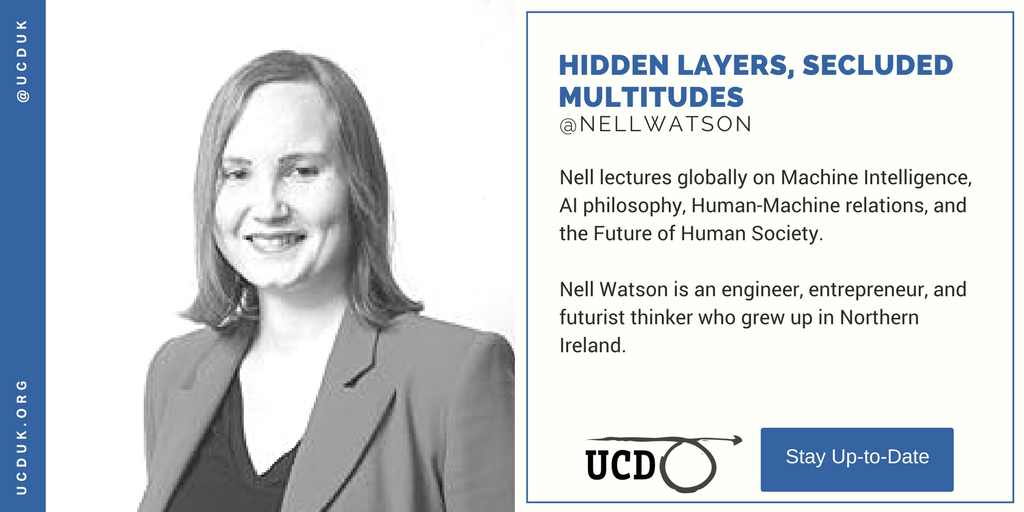
#OEB_midsummit Humanising machine learning by @nellwatson

Nell Watson spoke in her natural, slow paced way, bringing her message across in a steady, transparent voice.

Image result for nell watson twitter
Essentially any task a human brain can do in roughly one second processing time can now by replicated by a machine. Machines can recognise people, transcribe between languages, esthetic interpretation, make predictions. What we have today is something of a revolution, leading us towards intuitive intelligence is a force moving us to the next revolution. Increasing human intelligence, as most geniuses are alive today. We never had so many powerful brains with enormous outputs. The trouble is that the children that are entering the school today, 65 % will take up jobs that will not even exist today. So, how can we prepare our children. Certainly we can learn, but instead of chosing a role like a job, the children will have to learn from their strengths and skills to solve challenges or problems. We are moving towards the 3 c’s critical thinking, collaboration, complex problem solving. Scratch is an amazing tool, and one million projects are built and shared every single month. These tools can pluck together different ideas and make them real, it provides new insights by becoming a maker. It is also about sharing new ideas, it is like creating a gift, and see others remix it. Originality is overrated, as remixing is one of the greatest skills of this new age. To amplify and improve these skills are essential to help people to grow from each other and let objects grow.
Creativity and fantasy are essential for growth, the capacity for fantasy can help with machine learning and learning from machines. Any kind of creativity, can now be turned into something recognizable by machines [inge: why would you want this to happen?]
Machine intelligence helps to create new layers (cfr augmentation). Real time mash-ups between fantasy are resulting in new creativity [Inge: but examples are known things turned into other known things, so how is this interesting]. There are algorithms that can fill in the gaps in knowledge (like finding the dates of a specific photograph). This leads to further thoughts of children [Inge: but why would a child want a machine to tell it, how her or his drawing would be better, how does this promote fantasy?].
Machine learning can be a mediator between humans: machines can help to create a persuasive message: empathy is now growing in machine learning [Inge: wondering whether this is personal profile diversity organized?]. Staff empathy is the most searched for quality in communication.
Teaching children moral agency is important. Questioning assumptions in society.
There will be more and more machine learning entering all of our lives: elderly relatives helped by enhanced pets – robocat by mattel. But sometimes such research are spooky, like finding vulnerable children to turn them into consumers feeling better by materials for instance.
Machine driven panopticon becomes a reality. Now 3D sensors are embedded in smartphones to scan and understand the world and merge them together. It is now able to scan an object, analyse it and to put it back into reality again (shows funny cat movie).
Good stuff: text transformed into sign language. Or impactvision, looking inside fruit to see if fruit is ok. Same for health: looking into the body with smartphones (e.g. Koen Kas). Or making the heartbeat visible to the naked eye. Looking at fotos we can find gene combinations, or finding stress in animals and humans.
Machines can help to unbundle our own personal complexity, which we not seem to be able to do.
Intelligence is going to be embedded everywhere. Machines are helping us to ‘how best to spend our money’, so machines are already supporting and advising us in certain ways. Replika is a machine, and research shows that humans do not care talking to machines. One example is a dead person turned into AI, enabling the partner to talk to their dead partner after dead.
In some of our imagination we need to destroy the bots, but in truth we find that we can outgrow our human shyness as humans. The more we get familiar with machine learning, we become more open in opening up to machines in our lives, embedding them in our lives. There is of course the good and the bad. We cannot help to put on ‘personhood’ onto those robots. So if an identity is felt, we cannot help to anthropomorphize quit robots. Brains scans show humans feel for robots (shows movie with robot being hurt). Our species have sit around campfires, sharing stories… we are driven to connect with others, it is an intrinsic part of being humans. We are bound to connect with humans and non-humans.  USC institute for creative technologiesmultisense and simvoice interaction.
We are entering a world where the humans build sensitive relationships with machines. Technologies will make scarce things abundant (e.g. to respond to loneliness). But we need to learn from the lessons of the past.  
AI needs good influences and great role models. AI is growing up and is shaping the nature of humanity. Computational ethics or machine ethics, letting machines
OpenEth.org, helping to map ethics and explore dilemma’s [Inge look this up]. Nell thinks that non-fiction is for facts, and fiction is for values.
3 billion machines will come online within before 2020… and it will increase exponentially. We want to make it easy, working on scratch for ethics which uses emoji’s to help people link together ethics to emotions. Nell believes in the kindness era, if only we can come together collaboratively, building a human heart for machines.


#OEB_midsummit Surviving Digital Darwinism Tony Driscoll @wadatripp #corporate


Tony Driscoll – with nicely trimmed beard and liking jeans – takes the stage and starts with a bit of personal history, and how teaching was in his generational history. Full slide deck can be found below (fab drawings to support the message)

Why the future does not need us’ was an article that changed Tony’s life. He realized then that he was a techno positivist, but what would happen when something does not turn out positively, what really goes on in this intersection with technology. What will the technological effect be for current children, and what can we do in order to make them ready for the future.
Time is always part of the derivative for the rate of change, and distance and jerk. We know what velocity is, acceleration, but we do not know what jerk is (acceleration over time). Technology is currently jerking humanity around. So, the humans built a tech neural system that absorbs humans and defines how we interact and are connected. We – the humans – need to process more now than ever before, and our minds can no longer keep on top of this. The speed of life is increased, where wave upon wave of disruption by tech is coming and humans are not equipped for this. We have an inability to see catastrophy coming. For kids of today the tech disruptiveness will be even higher than in our lifetime, or the lifetime of our grandparents.
Business value progression and structural lag: so companies are catching up to create value in the market space. If the rate of change on the outside exceeds the rate of change on the inside the end is near – Jack Welch. The average age of companies is now 18 years, and it is decreasing.
Leveraging technology to achieve active and instant reactions.
Tony’s fear is that he and his sons is flying into a jerk hole.
Scenario’s:
Positive scenario: technology does not have a conscious, it just accelerates human fulfillment, the fly wheel of tech synchronise to open new frontiers for everybody. Empowerment for everyone, and all humans can live a happy life. But hope is not a strategy.
Enslaved scenario: tech limits the fulfillment in human identity. We reduce human dreams to fit the current form of the tech options. Always go to the always on answer box: google. At highest level it dums us down to IT laborers so we are back to a digital enslaving scenario.
Enmeshed scenario: post-human: implants, living longer, downloading emotions into a virtual environment to live longer or forever. But question is will this life be fulfilled, and are we willing to give up our unique human identity.
Worst scenario: extinguished: tech accelerates to a point where humans are no longer here. Tech is the next evolution.
But how can we prepare our kids for either the enslaved or the enmeshed trajectory.
Learning from experience: a story about a lost colony is shared with humor (uses superposition of old and new society) and at the end a question, resulting in the message: we need to unlearn and we must change learning.
We need to train people to figure it out (generative learning), collaborative learning, authentic learning, doing and learning, virtual ecologies, learner centered… quoting Jay Cross: optimizing our networks (internet and human).
[Inge, he uses a personal storyline to bring across a message that can be delivered in a multitude of options]

Tuesday, 13 December 2016

Free report & toolkit on MOOCs for development #MOOCs4dev #itcilo @alessiames

The International Training Centre for International Labour Organisation (ITCILO) has always been a forerunner in innovation for development purposes. When I met Alessia Messuti two weeks ago, she mentioned that ITCILO just published a free report and toolkit on MOOCs for development. The report is 29 pages and gives a brief, yet well-founded description of the past 5 MOOCs which were implemented since 2015 in which the ITC was involved with (including a MOOC on 'Crowdsourcing for Development'), and the report also highlights the challenges (business model, quality assurance, access barriers, and facilitation & teaching support quality). The pedagogical MOOC design they used is also mentioned and what I really liked was their non-video approach, as this enabled much more learners in developing settings to engage with the MOOC material.

If you read the report and are interested in more information, Alessia also made a toolkit available for those who want to learn more than just the basics mentioned in the report. You can ask for a copy of the more expanded MOOCs4Dev toolkit by emailing delta@itcilo.org .

It is a good read for all those in valuing the concept of education for all and what that means for MOOCs. 

Friday, 9 December 2016

Commenting & sharing free 5th innovating pedagogy report #pedagogy #EdTech #OU

While I was reading the latest innovative pedagogies report, some comments came to mind, which I will gladly share a bit further down this blogpost after a quick description of the report itself. Researchers from the Instituteof Educational Technology located at The Open University (UK) together with academics from the Learning Sciences Lab at the National Institute of Education in Singapore recently published the fifth Innovative pedagogy report. A full-text PDF version of this 47 page report is available to download from www.open.ac.uk/innovating. In the report they provide an overview of emerging innovative pedagogies. This report covers: learning through social media, the concept of productive failure as a pedagogical option, teachback, design thinking, learning from the crowd, learning through video games, formative analytics, learning for the future, translanguaging, and the blockchain for learning. The aim of the report is to explore new forms of teaching, learning and assessment for an interactive world, to guide teachers and policy makers in productive innovation. This fifth report proposes ten innovations that are already in currency but have not yet had a profound influence on education.

This is definitely an interesting report, as it offers a quick overview of emerging pedagogies. There have been prior reports that I found inspiring as well (previous reports can be found here). The introduction situates the current learning science and puts it within the increasingly interdisciplinary realm of learning and teaching, both formal and informal. While most introductions are merely synthesis of what can be expected, the introduction of this report offers a truly rich – yet brief – background to the report, adding what went before it and providing a state of the art overview of EdTech.

As an educational technologist, some of the innovative pedagogies seem familiar, e.g. learning through social media is a topic most of us are familiar with, but indeed, it is not always implemented as a recognised pedagogical policy. The report also emphasizes the need for educators/facilitators to be part of the learning process to allow truthful curation of content. The examples given of crowdsourced and facilitator driven social media accounts are really inspiring (@realtimeWOII and pepysdiary.com both using direct quotes from the past to bring it back to life).

The productive failure option fits with the flipped classroom/lecture approach, as it allows learners to first try out finding a solution on their own, possible failing at it, after which a teacher/instructor steps in. Giving the students room to creatively work around a problem they cannot solve at first, and discussing it. I like this approach. I would also like to see deliberate flawed research presentations, I mean giving faulty presentations first, asking the audience to indicate where they thought a faulty research method/deduction… had taken place and then rectify it as a presenter. I guess that would make a conference audience more attentive and make the whole process more inspiring. … Yes, I will use this in an upcoming presentation. Maybe even a classroom or lecture option.

The teachback approach is slightly related to the productive failure, in that it tries to limit failure in communicating. This approach comes from the medical world, and I remember doctors in training having to learn to listen to patients in order to really grasp the medical condition as it is portrayed by the patient. Teachback asks one person (usually an expert or teacher) to explain something they know about a topic to another person (usually someone new to the topic). Then the novice tries to teach their new understanding back to the expert. If the learner gives a good response, the expert goes on to explain some more about the topic.

Massive peer learning, or learning from the crowd fits the next level of networked learning, in its nicest form is the citizen learning, where people share what they learn in their contexts/locations with others. This is used in http://www.NQuire-it.org

Formative analytics, based on learning analytics but giving the learners tools to visualize their learning and possibly adjust their learning is an upcoming trend. But then again, I do wonder what are the chosen indicators for visualizing learning (is it the learner who decides or others that decides what matters in terms of learning?).

The translanguaging is something that is in need for accepting. Most of us global citizens speak at least two languages. Mixing languages to deepen understanding is something most of us have been doing, but is now growing interest in formalized learning and I am truly happy to see that, ik ben er echt blij om, vraiment ça me donne de l’énergie! Or to use my native dialect: doar zenn’k na ne kier echt blaai oem! 

Blockchain learning becomes interesting (a blockchain stores digital events securely on every user’s computer rather than in a central database). It is of interest, especially when we will be able to keep our learning trajectories openly accessible for personal use. Creating our own learning across formal and informal learning environments.

Anyhow the report provides new ideas, and new ways of creating learning opportunities. But … pedagogy is only one part of the learning equation and recently, I wonder whether we as educational technologists are not loosing serious learning/teaching ground. Education for all is slipping through our fingers as we dig deeper into pedagogies, yet deny current filter bubbles as results of algorithms. For people do indeed learn from social media, but this learning increasingly happens in isolated information islands… only rehashing what you like. This means that what I get to see through social media is increasingly what fits my views… this means the learning is decreasingly Socratic, for I am not provided with discussion food the way I (or dare I include we) I used to.

If we learn increasingly with the use of social media, we are increasingly learning from results that are filtered by non-transparent algorithms. Numerous algorithms that we are unaware off. Are we slowly being brainwashed, now more than ever before?

Wednesday, 7 December 2016

How can we be safe in an online environment? #oeb16 workshop

Workshops tend to take at least half a day to come to a result. But at OnlineEduca I had the pleasure of meeting Christian Friedrich and it is amazing what this man can inspire people to do in just 60 minutes time!

To tackle the subject of 'how can we be safe in an online environment' and let people come up with ideas they did not know they had before in such a small period of time... is amazing. Admittedly, his material would enable a flipped workshop approach. Where - as an ideal participant - you would read up on all the material before coming to the workshop, but in this case, the participants simply did not have the time. OnlineEduca was packed with sessions, and this workshop was organised at the end of day 1, meaning that most of the participants were already slightly tired.
But somehow this did not affect Christian, for he got us to come up with a short statement on how we could safeguard our own ideas and writings while sharing ideas online.

If you can get Christian in your conference, I am sure that the resulting workshop will give the attending participants ideas, let them think about privacy, security, identity and contemporary digital traces.

For this workshop, the participants need to identify with a specific target group, then think about potential online risks they might face, and how to counter these risks. So, in a way it was all about openness versus privacy & security. Some interesting links provided by Christian: the ethics of big data in higher education, an introduction to online privacy, and Lawrie Phipps with a great analysis on the effect of algorithms, and an audio recording with Audrey Waters and Kin Lane on Online Ownership.

This was the result from the team effort of Jeanine Reuteman, Luca Morini, Christian Glahn and Marit from Denmark (sorry, I did not remember the full name) and myself.