Showing posts with label activism. Show all posts

Tuesday, 4 June 2019

Part 2 on #Blockchain in #learning: some points of discussion

This is a second post on Blockchain in learning (specifically for certification, it is referred to as Blockcerts). In the first blogpost on the subject, I took a look at some examples that are currently out there (industry/academia), but in this post, I will have a closer look at the discussions surrounding Blockchain for learning. First I will zoom in on how I see Blockchain certification being the new big brother in an already very structured dominant education system. After that I share a prankster who conned himself into a professorship, then an example from Russia, and to finish the blogpost, a quick overview of one of the major critiques on blockchain. First off: fight the power!

Blockchain the move from freedom to the rigid, dominant system in learning
In history and innovation, there is always the first momentum which feels like liberation and promises a minor or major new Utopia (the emergence of television: education for all right in your living room; Internet: education at our fingertips; MOOCs: free education for all by highly acclaimed institutions, ... and now blockchain: certification for our lifelong learning, right in our mobiles). Blockchain certification is cutting out the middle person and making sure that all transactions move from user-to-user (where the user might be any person or company that is at one end of a transaction). At first, the promise of secure data transition is felt like new freedom to some, but once the technology gets more embedded and used by more people, a more rigorous system kicks in, the dominant system.

To me, it feels like dominant learning is reeling all of us, informal learners, back in, and blockchain certification might just be a strong example. Why would blockchain be a ball-and-chain from the dominant system? Easy, it now stacks formal certification, which means it becomes even more difficult to live and develop outside of the pre-set pathways of life (if you want a professional career that is). Why would this be necessary? Well, not all of us want to pull pranks, not all of us want to live outside of the set boundaries (study, go to uni, work and climb the ladder within a specific branch), but some of us do like a bit of job freedom. I for instance like switching jobs, and retaining some freedom while performing to the best of my abilities.

Our human right to pull pranks within the educational establishment
For me, we - as humans - need the freedom to pull off a prank from time to time. Nothing as big as full-blown fraud, but just something small to satisfy our inner fool.

I remember a prank that Gogol pulled off which actually went against the rigid educational system of his time. Gogol was a famous Russian author using quite a bit of surrealism in his books, eg. The Nose. At a certain point in his life, he could earn enough money, so he was looking for a means to earn money, and he managed to earn a chair as Professor of Medieval History at the University of St. Petersburg, a job for which he had no qualifications. He pulled this off for a year (not giving lectures, keeping all the information very general, and taking exams with a towel wrapped around his so-called toothache, so that he did not have to talk and another professor took the exams of the students. Great! I mean, let's be serious, this is something that makes all of us pranksters laugh. It takes a serious position and turns it into a very human momentum. Let's be honest, no robot or cyborg would do this, only humans can come up with such a beautifully orchestrated prank.
However stupid a fool's words may be, they are sometimes enough to confound an intelligent man. Gogol, Dead Souls.     
Blockchain certification is for idiots who cannot pinpoint real knowledge or expertise
Sometimes Blockchain certification is promoted with: "it takes away the risk of hiring someone who has not gotten the degrees that the person says they have". So what? If you cannot tell if someone had or didn't have an education based on what they deliver in terms of work, it sure means they were intelligent enough to really grasp those skills and experiences in their own way. If they cannot pull it off, it does not matter whether they had the qualifications in a formal way or not either, because if they cannot do the job, no matter which qualifications they have, you will fire them. So in a way certification is only a fools tool within a dominant system that agrees it is too difficult to distinguish real earned certification versus fraudulently earned certification. Or is it?

Universities are no longer on top of the educational ladder: the Russian implementation
In my previous post, I mentioned a couple of Blockchain certification options, but since then I came across a more advanced blockchain in learning example, and it is a Russian implementation called Disciplina. This platform combines education (including vocational training), recruiting (comparable with what LinkedIn is doing with its economic graph) and careers for professionals. All of this is combined into a blockchain solution that keeps track of all the learners' journey. The platform includes not only online courses as we know it but also coaching. After each training, you get a certificate.
TeachMePlease, which is a partner of Disciplina, enables teachers and students to find each other for specific professional training as well as curriculum-related children's schooling. Admittedly, these initiatives are still being rolled out in terms of courses, but it clearly shows where the next learning will be located: in an umbrella above all the universities and professional academies. At present, the university courses are being embedded into course offerings by corporations that roll out a layer post-university, or post-vocational schooling.

Europe embraces blockchain, as can be seen with their EU Blockchain observatory and forum. And in a more national action, Malta is storing their certifications in a blockchain nationwide as well. We cannot deny that blockchain is getting picked up by both companies and governments. Universities have been piloting several blockchain certification options, and they also harbor some of the leading voices in the debate on blockchain certification.

Major critique on Public Blockchains for learning
First of all, and prominently present, is Serge Ravet. He is co-author of the Bologna Open Recognition Declaration, founding partner of the Open Recognition Alliance, which already offers a good deal of interesting blockchain for learning related reading. On his learning futures blog, Serge wrote a couple of articles on why he thinks that blockchain for learning is not the way to go and is, in fact, solving a false problem. http://www.learningfutures.eu/2019/01/its-about-trust-stupid-why-blockchain-based-blockcerts-are-the-wrong-solution-to-a-false-problem-0-3/ . While going head-on, he pinpoints the real actor behind the EU blockchain observatory and forum, he then goes on to state that blockchain promotion is based on the promotion of the idea of distrust. When I read this, I concurred to the notion, as indeed there is another way to certify education and learning, that is by using the Web of Trust.
The blockchain is sometimes presented as the new panacea needed to heal the wrongs of the world. It is not just superficial, it is plain wrong: some applications of blockchain technologies can make things worse than they were, like the Bitcoin and other cryptocurrencies that are not just boosting traditional criminal activities but enabling new ones, not to mention global warming. (It’s about Trust, Stupid! Why Blockchain-based BlockCerts are the wrong solution to a false problem (0/3) by Serge Ravet)
In his follow-up post Serge zooms in on the economic-dimension of using blockchains, notably the actual risk of erasing regulatory bodies, and one of the most irregulated markets, the cryptocurrency market. He states:
The rationale for the initial development of blockchain technologies like Bitcoins, was to solve the problem of double spending while simultaneously:
  • Getting rid of regulatory bodies — the dream of the proponents of anarcho-capitalism also called libertarian anarchy, one of the ideologies widely shared between the alt-right, Trump and Silicon Valley (c.f. their track-record in tax dodging).
  • Getting rid of the need for trusted authorities to secure transactions — which resulted in creating an ecosystem that works best when everybody is at war with everybody. Trust is a mortal sin as trust between the [blockchain] miners could lead to collusion and cheating. 
 This puts a large part of society in a precarious position, as blockchains are pushed as being secure, while actually not only cutting away the middle man, but also the regulators, and the only ones really benefitting from having no regulators are those in power.

Another well-known downside of blockchains is their impact on global warming (definitely regulators needed there).
Public blockchains based on Proof of Work (PoW) are actively contributing to global warming—Bitcoin operations consume the annual energy of New Zealand, and growing! (It’s about Trust, Stupid! Why Blockchain-based BlockCerts are the wrong solution to a false problem (1/3) by Serge Ravet.
He also dispels the blockchain myth in pointing to how easy it is to get funding if you use 'blockchain' in any type of way.
What I really like, and often think, is that there is not always a need for blockchain. There are other options that do the job you want and have less impact on the climate, as well as less impact on society (so keeping it a low risk).

When addressing blockchain for certification, he hits on similar ideas as I did in the beginning of this post (though Serge uses a much more literary and blockchain-tech angle). And he uses some bitter wit as well:
The blockcert-authors want to use blockchains to reinvent the teaching machine that B. F. Skinner imagined for humans out of his extensive study of pigeons. But with an interesting twist this time: the positive reinforcement is not for the students, but the teachers; and it is financial! ... If the goal is to “enable a wave of innovation” what kind of innovation could emerge from making credentials “cryptographically signed, tamper-proof, and shareable”? The only innovation here is in using a new technology to improve paper-based credentials. We had a piece of paper, a static piece of information that is now a digital record, just as well a static piece of information, but easier to share and more difficult to tamper with.
When reading this last paragraph, it dawned on me that blockchain certification might well be a contemporary version of the Emperors New Clothes. Ah, so that means blockcerts might be a prank after all?! That idea feels satisfying, I no longer need to search a viable product for my project... or do I ? 

Sunday, 8 October 2017

Free webinar: language learning apps and MOOCs for refugees

This one hour free webinar focuses on language learning apps and some used within MOOCs for refugees. The idea is to increase social inclusion and enhance employability for new arrivals. However, the language learning apps can also be an addition to other formal learning (e.g. for students who recently came to live in a new country and are attending regular school but who can use personalised language support, anyone moving to another country where they need to learn another language (ex-pats, immigrants), to anyone simply interested in keeping up to date with a language they have learned (e.g. my French needs refreshing).

Free webinar link and registration information:
https://moonliteproject.eu/events/webinars/language-learning-apps-moocs-for-refugees/


When: Wednesday 25 October, 15.00-16.00 CEST (Central European Summer Time, to know when the webinar takes place in your timezone you can look at Time Zone Converter here: https://www.timeanddate.com/worldclock/converter-classic.html )
Where: Online via Adobe Connect (so check the link to the webinar once it is sent to you).
You need to register for this free webinar (link here), this means you need to add your firstname, name and organisation (if you are not linked to an organisation, simply put 'virtual network' or similar).  

The link to the webinar room will be sent to all registered participants one day before the event.

Speakers:
Agnes Kukulska-Hulme: mobile language learner by excellence, The Open University, UK
Timothy Read: computer languages and systems (also set up first MOOCs in Spain), UNED, Spain
Alastair Creelman: elearning specialist, Linnaeus University, Sweden.

What to expect
The question being considered in this webinar is whether such resources represent an effective learning approach for refugees given their changing geographical, sociocultural and technological circumstances?
An important part of social inclusion is having the foreign language skills necessary for day to day life. ICT, including mobile apps and open online courses, forms an important part of the way in which languages are learnt in our modern society. The improvement in communication networks and online tools, accessible from a range of mobile devices and desktop computers, facilitate activities developed to improve the four basic language competences (written and oral comprehension and production). Furthermore, the wide availability of free language learning apps can help to supplement the online learning experience, especially when network access is limited.


The webinar is organised by the Erasmus+ project MOONLITE in cooperation with EDEN (European Distance and E-learning Network), NVL Distans (Nordic Network for Adult Education) and the Swedish Network for IT in Higher Education (ITHU). The Moonlite project focuses on MOOCs for social inclusion and employability.

Friday, 9 June 2017

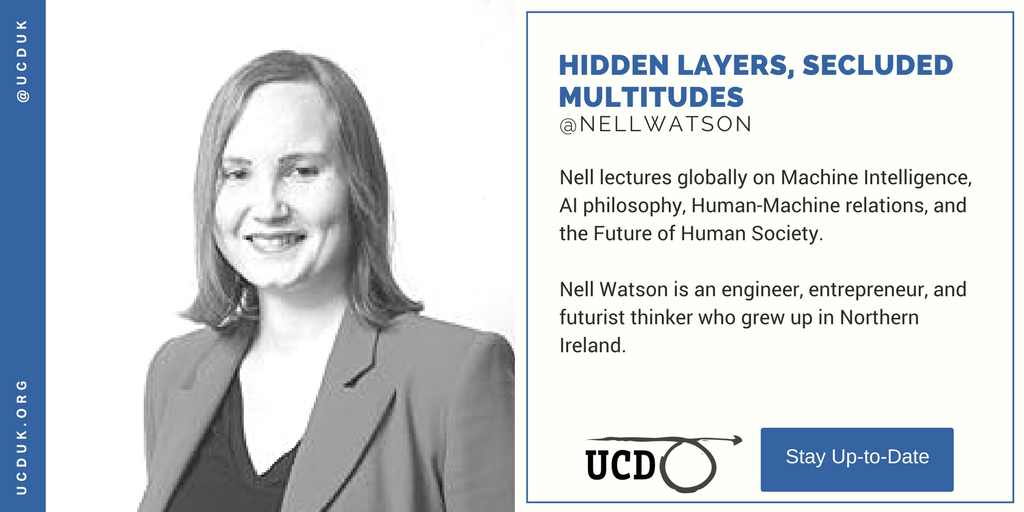
#OEB_midsummit Humanising machine learning by @nellwatson

Nell Watson spoke in her natural, slow paced way, bringing her message across in a steady, transparent voice.

Image result for nell watson twitter
Essentially any task a human brain can do in roughly one second processing time can now by replicated by a machine. Machines can recognise people, transcribe between languages, esthetic interpretation, make predictions. What we have today is something of a revolution, leading us towards intuitive intelligence is a force moving us to the next revolution. Increasing human intelligence, as most geniuses are alive today. We never had so many powerful brains with enormous outputs. The trouble is that the children that are entering the school today, 65 % will take up jobs that will not even exist today. So, how can we prepare our children. Certainly we can learn, but instead of chosing a role like a job, the children will have to learn from their strengths and skills to solve challenges or problems. We are moving towards the 3 c’s critical thinking, collaboration, complex problem solving. Scratch is an amazing tool, and one million projects are built and shared every single month. These tools can pluck together different ideas and make them real, it provides new insights by becoming a maker. It is also about sharing new ideas, it is like creating a gift, and see others remix it. Originality is overrated, as remixing is one of the greatest skills of this new age. To amplify and improve these skills are essential to help people to grow from each other and let objects grow.
Creativity and fantasy are essential for growth, the capacity for fantasy can help with machine learning and learning from machines. Any kind of creativity, can now be turned into something recognizable by machines [inge: why would you want this to happen?]
Machine intelligence helps to create new layers (cfr augmentation). Real time mash-ups between fantasy are resulting in new creativity [Inge: but examples are known things turned into other known things, so how is this interesting]. There are algorithms that can fill in the gaps in knowledge (like finding the dates of a specific photograph). This leads to further thoughts of children [Inge: but why would a child want a machine to tell it, how her or his drawing would be better, how does this promote fantasy?].
Machine learning can be a mediator between humans: machines can help to create a persuasive message: empathy is now growing in machine learning [Inge: wondering whether this is personal profile diversity organized?]. Staff empathy is the most searched for quality in communication.
Teaching children moral agency is important. Questioning assumptions in society.
There will be more and more machine learning entering all of our lives: elderly relatives helped by enhanced pets – robocat by mattel. But sometimes such research are spooky, like finding vulnerable children to turn them into consumers feeling better by materials for instance.
Machine driven panopticon becomes a reality. Now 3D sensors are embedded in smartphones to scan and understand the world and merge them together. It is now able to scan an object, analyse it and to put it back into reality again (shows funny cat movie).
Good stuff: text transformed into sign language. Or impactvision, looking inside fruit to see if fruit is ok. Same for health: looking into the body with smartphones (e.g. Koen Kas). Or making the heartbeat visible to the naked eye. Looking at fotos we can find gene combinations, or finding stress in animals and humans.
Machines can help to unbundle our own personal complexity, which we not seem to be able to do.
Intelligence is going to be embedded everywhere. Machines are helping us to ‘how best to spend our money’, so machines are already supporting and advising us in certain ways. Replika is a machine, and research shows that humans do not care talking to machines. One example is a dead person turned into AI, enabling the partner to talk to their dead partner after dead.
In some of our imagination we need to destroy the bots, but in truth we find that we can outgrow our human shyness as humans. The more we get familiar with machine learning, we become more open in opening up to machines in our lives, embedding them in our lives. There is of course the good and the bad. We cannot help to put on ‘personhood’ onto those robots. So if an identity is felt, we cannot help to anthropomorphize quit robots. Brains scans show humans feel for robots (shows movie with robot being hurt). Our species have sit around campfires, sharing stories… we are driven to connect with others, it is an intrinsic part of being humans. We are bound to connect with humans and non-humans.  USC institute for creative technologiesmultisense and simvoice interaction.
We are entering a world where the humans build sensitive relationships with machines. Technologies will make scarce things abundant (e.g. to respond to loneliness). But we need to learn from the lessons of the past.  
AI needs good influences and great role models. AI is growing up and is shaping the nature of humanity. Computational ethics or machine ethics, letting machines
OpenEth.org, helping to map ethics and explore dilemma’s [Inge look this up]. Nell thinks that non-fiction is for facts, and fiction is for values.
3 billion machines will come online within before 2020… and it will increase exponentially. We want to make it easy, working on scratch for ethics which uses emoji’s to help people link together ethics to emotions. Nell believes in the kindness era, if only we can come together collaboratively, building a human heart for machines.


#OEB_midsummit Audrey Watters on personalization & pigeons


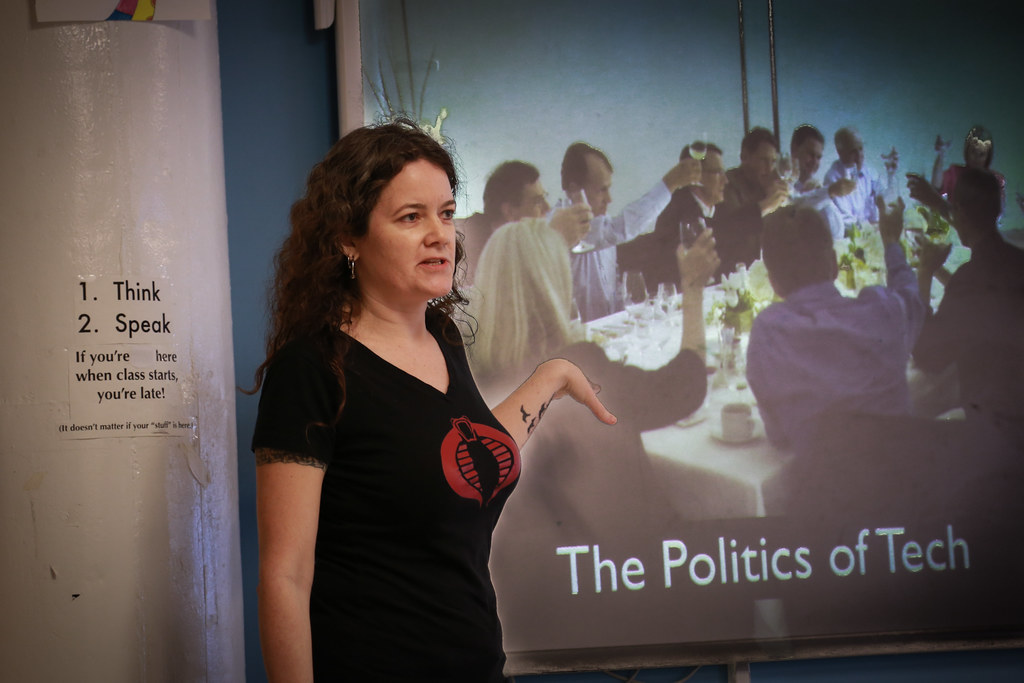
Image result for audrey watters Very excited to see Audrey Watters in action in real life after having read her posts and keynotes on many occasion where my mind was in need of critical analysis of contemporary learning and society. She is wearing some fabulous boots (!) and looks fierce as ever.
There is no agreed upon definition of personalized learning. There is a history of people working in tech, she refers to disruptive narrative often accompanying the technological discourse. The invention of education is filled with slogans, imagined histories… and they add to the narrative of Edtech and its perceived disruption.
Currently, there is a hype towards the need for personalized learning. This could mean that students to move through content at their own pace. Or personalized learning could mean that the students get to determine the topics. Or it could mean that it is personalized by students visions, ideas. It can be driven by student needs or abilities, navigating through education. Or personalized learning will only be attained through computer technologies, through automation of everything, the tech being the salvation.
The history is filled with traceable legacies on what education is, and this points towards your philosophical and political (and economic) views/values.
The latest influence of ‘philantropics’ putting their money in one type of definition of personalized learning, has a profound impact on education.
The definition of personalized learning today is related to 1903, individual learning can be traced back to 18th century. This shows that personalized learning is a very recent development where the individual learning was replaced in personalized learning.
‘rugged individualism’ is a core American ideology, particularly Sillicon Valley (back to frontier days). This is also deeply intertwined with contemporary capitalism. Post-war consumer capitalism. Personalisation acts as a salve for standardization, in an age of mass consumption (name on coke bottle to make it feel special). Personalisation is related to customization, more than actual tailored to the person’s own needs.
So, how much of personalization is this contemporary definition: think MOOC, think online courses, online tech, … we even have the ‘personal’ computer (oh, I like this parallel and critical realization).
Pressey (name not sure) made an automated teacher, and wrote a practical guide on standardized testing. By the 1920’s standardization was already embedded in the American educational system.
The message that automation is going to free the teacher is also very perverse. It is not about labor saving devices. The automated teacher was seen as a need for personalization, but it was in fact a response on standardization.  
Self-management, self-help has got…
[suddenly Audrey completely lights up when she mentions the link between pigeons and education, and that she could go on for hours on this link… it reminds me of my grandfather who had pigeons that entered competitions – blauwe geschelpte his type of pigeons were called].
All the smart people fucked up education, and no one takes responsibility. There is currently a death of expertise, this has an impact on the future of education, of society. How does an algorithmically driven FB news impacts ‘the news’.
Freedom of the state is the cost of education being supported by private money. Schools suddenly need to use the buzzword personalization, but there is no government oversight, and no appeal to civil and human rights in the face of the shift of personalized learning. In democracies one can wonder whether we can maintain shared responsivities for collective justice when our institutes are taken down.