Showing posts with label emoocs. Show all posts

Tuesday, 19 February 2019

Just sharing a few rejections: paper & funding, and solutions #academicLife #life #loveMyNetwork


Life can be hard, both personally and professionally, yet at the same time life can simply push you towards a more pleasant option along the way, seemingly using rejections to get you on to the right track. I sure hope this will be the case, but only hindsight will tell. [addition one day after writing this post: while sharing these ideas on Facebook, I got such an inspiring response from my network, I decided to add the ideas and remarks they had below, between square brackets]
Today I was informed that my co-authored paper for the eMOOC summit 2019 in Naples was rejected. Rejections rarely result in joy, and this was no exception. For some reason writing a paper is also a personal effort. You try with all your ability (and mostly under a bit of time pressure) to come up with a paper that shares your research in just a few pages. Referencing to prior great minds in your field of expertise. So, when a paper gets rejected, it simply hurts. It feels personal to some extent.
The rejection came one week after my submission to get a prestigious Marie Curie Fellowship got rejected as well, it did not get the threshold. The review did have a lot of positive points though (which did soften the blow). Granted, I wrote this submission as a plan B in order to increase my options to get back to work after I recovered from the year rehab after the cancer diagnosis. I put my heart into it, not only me but also the professor who was willing to employ me in his department if the fellowship was successful. Luckily, I was able to get back to work and on good terms, and on an inspiring project.
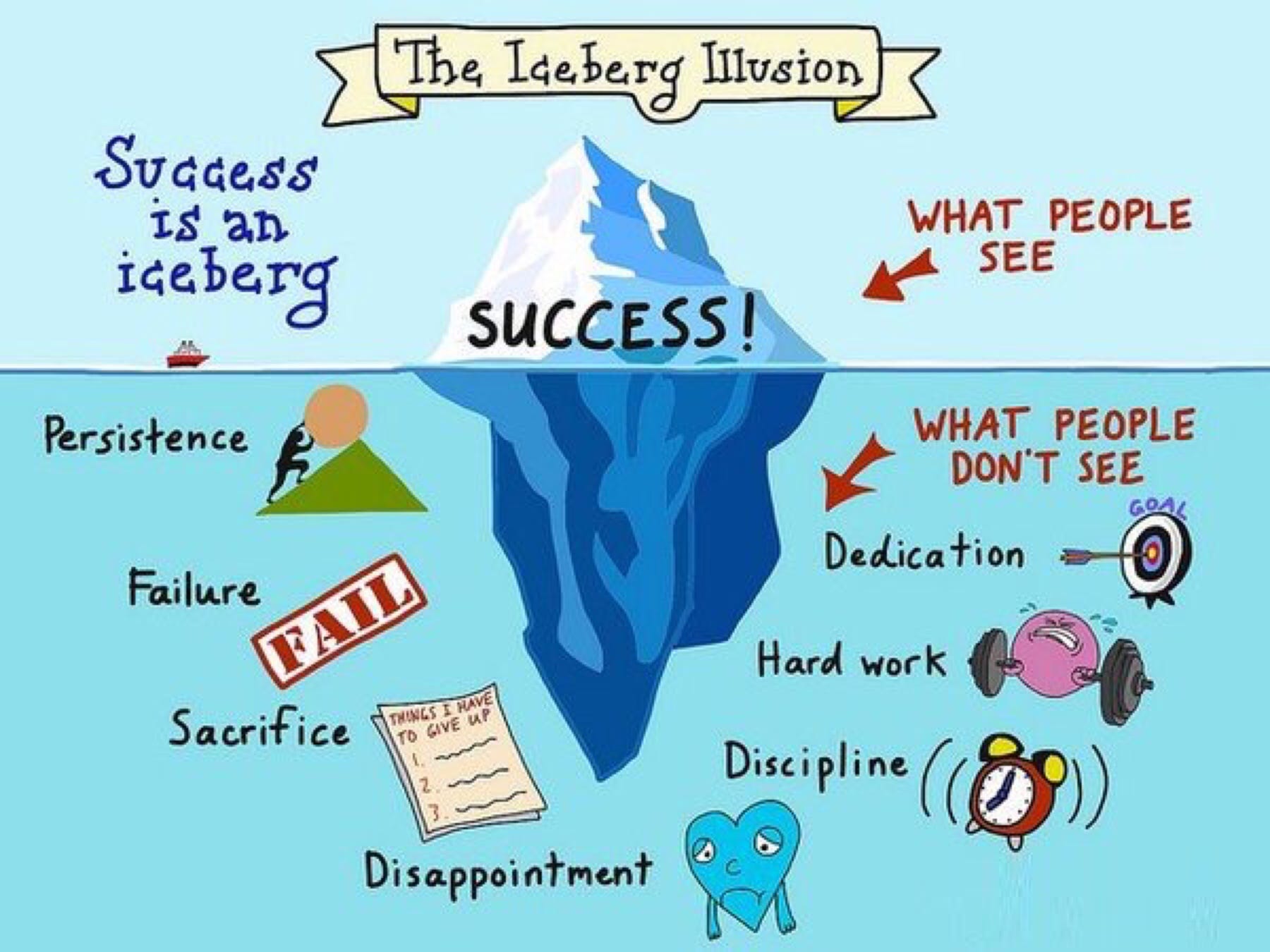
[It seems that rejections are common to everyone, even the highest esteemed scholars get them despite their obvious wisdom and knowledge. My friends shared some good advice and resources that help to bounce back from rejection. First off: upward and onward, as simple as it sounds, it works ... once you have managed to soften the feeling of a work being rejected. The process is to reflect, look at the feedback (or if they did not send any, ask for all the feedback, of course, anonymized), and rewrite and resubmit. Next, a great article in Medium on The Iceberg Illusion, adding the picture here as well.]

But the above two rejections just made me realize once more that I am not a traditional academic and as such, I doubt whether I can ever be part of the whole deal. Maybe this frequency of rejection is simply normal, but at present, I just feel I need to take another leap. Just like I did three times before. Maybe I am not made to gradually move forward? Maybe my thing is just this .... jumping ahead and then working on that 'new' concept until it becomes more mainstream.
[Feedback is an essential first step, next of course is to get going and to know thy self. And to repeat to yourself that critique is not personal, and it can be based on a number of reasons that do not even have to be immediately related to the work you did. In a way, emotion wins over ratio every time, but that does not mean we cannot rationalize after the first emotions have gone.]
Ciska sometimes tells me: "don't wine because you are living off the beaten track, even if you could walk the straight and narrow, you still would roll out your own route to get to the next place". Maybe she is right, but it does not make things easier. Maybe, it is never easy for any of us. Even for those who walk the more traditional roads to achieve a professional space in society. I don't know, but each time I get such a rejection, I just feel it's because of me, and it feels personal.
Okay, time to move forward again. Working on a project which combines human resources, AI and learning... fun, I must admit.
[and this is - and has always been - an inspiring Last Lecture]


Cartoon in this blogpost is from the fabulous Nick D. Kim - the http://www.lab-initio.com/ site

Friday, 4 January 2019

Call for Papers #CfP #AI #mLearning #MOOC in conferences #UNESCO @FedericaUniNa

January has started and three important calls for papers are coming up, all related to conferences. The three conferences are: eMOOCs2019 (on MOOCs), Mobile Learning week at UNESCO (focus on AI for development and mobile learning, and eLearning Africa (this year in Cote d'Ivoir), listed per deadline of the CfP.

Mobile learning week UNESCO (Paris, France): focus on AI for sustainable development
Call for proposals deadline: 11 January 2019
UNESCO Global AI Conference: Monday 4 March 2019
Policy Forum and Workshops: Tuesday 5 March 2019
Symposium: Wednesday 6 & Thursday 7 March 2019
Strategy labs & International Women’s Day: Friday 8 March 2019
Exhibits: Monday 4 to Friday 8 March 2019
More information: https://en.unesco.org/mlw/2019
UNESCO, in partnership with its confirmed partners – the International Telecommunication Union and the Profuturo Foundation – will convene a special edition of Mobile Learning Week (MLW) from 4 to 8 March 2019, at the UNESCO Headquarters building in Paris (France). The five-day event, under the theme ‘Artificial Intelligence for Sustainable development’ will start with the ‘Global Conference - Principles for AI: Towards a humanistic approach?’, followed by a one-day Policy Forum and Workshops, a two-day International Symposium and a half-day of Strategy Labs. On 8 March, towards the close of MLW, participants will be invited to join the celebration of International Women’s Day, particularly a debate on Women in AI to be held in UNESCO Headquarters. During the entire week, exhibitions and demonstrations of innovative AI applications for education and more than 20 workshops will be organized by international partners and all programme sectors of UNESCO.
eMOOCs 2019 in Napels, Italy
Deadline CfP: 14 January 2019.
Conference date:  May 20 – 22, 2019
More informationhttps://emoocs2019.eu/call-for-papers/overview/
Description
The Higher Education landscape is changing. As the information economy progresses, demand for a more highly, and differently, qualified workforce and citizens increases, and HE Institutions face the challenge of training, reskilling and upskilling people throughout their lives, rather than providing a one-time in-depth education. The corporate and NGO sectors are themselves exploring the benefits of a more qualified online approach to training, and are entering the education market in collaboration with HE Institutions, but also autonomously or via new certifying agencies. Technology is the other significant player in this fast-changing scenario. It allows for new, data-driven ways of measuring learning outcomes, new forms of curriculum definition and compilation, and alternative forms of recruitment strategy via people analytics.

At the MOOC crossroads where the three converge, we ask ourselves whether university degrees are still the major currency in the job market, or whether a broader portfolio of qualifications and micro-credentials may be emerging as an alternative. What implications does this have for educational practice? What policy decisions are required? And as online access eliminates geographical barriers to learning, but the growing MOOC market is increasingly dominated by the big American platforms, what strategic policy do European HE Institutions wish to adopt in terms of branding, language and culture?

The EMOOCs 2019 MOOC stakeholders summit comprises the consolidated format of Research and Experience, Policy and Business tracks, as well as interactive workshops. Original contributions that share knowledge and carry forward the debate around MOOCs are very welcome.

eLearning AFrica - Abidjan - Cote d'Ivoir
Deadline CfP: February 22, 2019.
Conference date: October 23 - 25, 2019
More informationhttps://www.elearning-africa.com/programme_cfp.php
Description
The 14th edition of eLearning Africa, the International Conference & Exhibition on ICT for Education, Training & Skills Development, which will take place in Abidjan, Côte d'Ivoire from October 23 - 25, 2019 and is co-hosted by the Government of Côte d'Ivoire. 

A unique event, Africa’s largest conference and exhibition on technology supported learning, training and skills development, eLearning Africa is a network of leading experts, professionals and investors, committed to the future of education & training in Africa.

Read more about the eLearning Africa 2019 themeThe Keys to the Future: Learnability and Employability, and become involved in shaping the conference agenda by proposing a topic, talk or session here.
Register today to profit from our Early Bird Rate

About eLearning Africa
Founded in 2005, eLearning Africa is the leading pan-African conference and exhibition on ICT for Education, Training & Skills Development. The three day event offers participants the opportunity to develop multinational and cross-industry contacts and partnerships, as well as to enhance their knowledge and skills.
Over 13 consecutive years, eLearning Africa has hosted 17,278 participants from 100+ different countries around the world, with over 80% coming from the African continent. More than 3,530 speakers have addressed the conference about every aspect of technology supported learning, training and skills development.

Tuesday, 13 November 2018

#MOOC free report, event MOOC for refugees (w travel fund options) and #CfP eMOOC2019

Two interesting MOOC events coming up one focused on MOOCs for refugees, and one for all you out there involved in researching or experiencing MOOCs (the eMOOC2019 conference). 

Free MOOC report

Linked to the MOONLITE event, there is a free MOOC report (130 pages) on “Exploiting MOOCs for Access and Progression into Higher Education Institutions and Employment Market”
The report gives an overview of the goals of the project, the methodology, and finishes with the practical recommendations for using online courses to enhance access and progression into higher education and the employment market (for refugees). 

MOONLITE multiplier event (part of a EU Erasmus+ project)

The MOONLITE event supports learning without borders, practically it harnesses the potential of MOOCs for refugees and migrants to build their language competences and entrepreneurial skills for employent, higher education, and social inclusion. 

There are bursaries to help cover your travel expenses which you can apply for at the venue!
23-24 November, UNED (Madrid, Spain).
Friday November 23
15:20. Welcome (Timothy Read & Elena Barcena, UNED, Spain)
15:30-16:30. Presentation of the MOONLITE project and its outputs (Jorge Arús-Hita, UCM, Spain & Beatriz Sedano, UNED, Spain)
16:30-17:30. Open Education Passports and Micro Credentials for refugees and migrants (Ildiko Mazar, Knowledge Innovation Centre, Malta)
17:30-18:00 Coffee
18:00-19:00 Kiron Educational Model and Quality Assurance for MOOC-based curricula (María Bloecher, Kiron, Germany)
Saturday November 24
10:00-11:00:  Inclusive by design: how MOOCs have the potential to reach people in ways other online courses do not (Kate Borthwick, University of Southampton, UK)
11:00-12:00: A tool for institutions for quantifying the costs & benefits of Open Education (Anthony Camilleri, Knowledge Innovation Centre, Malta)
12:00-12:30 Coffee
12:30-13:30: Workshop on how to design a socially inclusive MOOC (Elena Martín- Monje & Timothy Read, UNED, Spain)
13:30. Farewell (Timothy Read & Elena Barcena, UNED, Spain)

See travel details, online registration and more info here. No attendance fee. Limited places. 
➢ Sign up here: https://goo.gl/forms/RXYWS8MiQgYqfLkC2 (to obtain attendance certificate, materials, coffee).
➢ Venue: C/ Juan del Rosal, 16 - 28040 Madrid. How to get there: Metro until the stop: “Ciudad Universitaria” + Bus “U” until
the stop: UNED-Juan del Rosal: http://www.ia.uned.es/llegar-etsii

Call for papers eMOOC2019

Dates: 20 - 22 May 2019 
Venue: University of Naples, Federico II in Italy

Important Dates:
16 Jan 2017: Paper submissions for Research Track.
24 Feb 2017: Notification of acceptance/rejection
20 Mar 2017: Camera-ready versions for Springer LNCS Proceedings and copyright form.

The Higher Education landscape is changing. As the information economy progresses, demand for a more highly, and differently, qualified workforce increases, and HE Institutions face the challenge of reskilling and upskilling people throughout their lives. The corporate and NGO sectors are themselves exploring the benefits of a more qualified online approach to training, and are entering the education market in collaboration with HE Institutions, but also autonomously or via new certifying agencies. Technology is the other significant player in this scenario. It allows for new, data-driven ways of measuring learning outcomes, new curriculum structures and alternative forms of recruitment strategy via people analytics.

MOOCs represent the crossroads where the three converge. Come to EMOOCs 2019 and explore the impact and future direction of open, online education on a social, political and institutional level.

The eMOOC summit has four tracks: research, business, policy and experience track.
At the MOOC crossroads: where academia and business converge

The Higher Education landscape is changing. As the information economy progresses, demand for a more highly, and differently, qualified workforce and citizens increases, and HE Institutions face the challenge of training, reskilling and upskilling people throughout their lives, rather than providing a one-time in-depth education. The corporate and NGO sectors are themselves exploring the benefits of a more qualified online approach to training, and are entering the education market in collaboration with HE Institutions, but also autonomously or via new certifying agencies. Technology is the other significant player in this fast-changing scenario. It allows for new, data-driven ways of measuring learning outcomes, new forms of curriculum definition and compilation, and alternative forms of recruitment strategy via people analytics.

At the MOOC crossroads where the three converge, we ask ourselves whether university degrees are still the major currency in the job market, or whether a broader portfolio of qualifications and micro-credentials may be emerging as an alternative. What implications does this have for educational practice? What policy decisions are required? And as online access eliminates geographical barriers to learning, but the growing MOOC market is increasingly dominated by the big American platforms, what strategic policy do European HE Institutions wish to adopt in terms of branding, language and culture?

The EMOOCs 2019 MOOC stakeholders summit comprises the consolidated four-track format of Research and Experience, Policy and Business. And will feature keynote speakers, round table and panel sessions as well as individual presentations in each track. The aim is for decision-makers and practitioners to explore innovative and emerging trends in online education delivery, and the strategic policy that supports them. Original contributions that share knowledge and carry forward the debate around MOOCs are very welcome.The number of HE institutions involved in MOOCs, and the numbers of courses and enrolled students, has increased exponentially in recent years both in Europe and beyond. One of the results of this growing MOOC movement is an increasing body of research evidence that positions itself within the established research communities in technology enhanced learning, open education and distance learning. Key trends that are accelerating HE technology adoption are blended learning design and collaborative learning as well as a growing focus on measuring learning and redesigning learning spaces, and, in the long-term, deeper learning approaches and cultures of innovation.

This track welcomes high-level papers supported by empirical evidence to provide a rigorous theoretical backdrop to the more practical approaches described in the experience track, and particularly invites contributions in the area of these key trends.

  • Learning Designs – blended learning, collaborative learning, learner-generated content, open textbooks, immersive learning, relating course and content to learning outcomes
  • Defining and Measuring learning – learning analytics, educational data mining, user behaviour studies, adaptive and personalisation studies, cognitive theories and deep learning
  • Technology – infrastructure and interface, tools and methods to provide learning at scale; tools and methods for assessment; tools and methods for data collection and processing; blockchain technology; AI + automated feedback

Submission of Papers
This is a one-step process, via direct submission of abstract and full paper.

Full paper: up to 10 pages including references

There will be official conference proceedings for this track and submissions will be handled through EasyChair.

The use of the supplied Springer template is mandatory: https://www.springer.com/it/computer-science/lncs/conference-proceedings-guidelines

Please remember to indicate the relevant Track when you submit your paper.

Proceedings

The Proceedings of the Research Track will be published by Springer in the Lecture Notes in Computer Science (LNCS) Series.
Submission of Work-in-Progress Short Papers

Short papers (up to 6 pages) are also accepted in this track, reflecting work in progress, for publication in Online proceedings with ISBN.

The use of the Springer template is mandatory:
https://www.springer.com/it/computer-science/lncs/conference-proceedings-guidelines

When submitting your paper, please indicate type of paper and track in the submission process.

Proceedings

The Work-in-Progress proceedings will be submitted to CEUR-WS.org for online publication. Outstanding short papers may be included in the Springer Proceedings.

Important dates:
25 February 2019: Short Paper submissions for Research Track.
25 March 2019: Notification of acceptance/rejection
29 April 2019: Camera-ready versions for online Proceedings with ISBN and copyright form

Monday, 21 March 2016

Self-regulated learning for measuring motivation & self-esteem in #MOOC #motivation #SRL

For those interested in self-regulated learning, building upon the knowledge which is created over the years, I gladly share a recently published paper, which is part of the eMOOCs2016 proceedings. The project is briefly explained, and in this paper we (the authors) also refer to the self-regulated learning instrument which is used to monitor young students (16-17 year old) while they follow MOOCs to enhance their personal interests. The goal of this project is to increase (online) lifelong learning skills. The paper includes a reference to a SAM-scale for attitude and skills measurement, focusing on language skills (i.e. practical use of language: speaking, listening), and digital skills such as critical thinking.
The paper gives an update on a year long project which runs at GUSCO, a large and innovative secondary school in Kortrijk, Belgium, for which I lead the research end of the project (in participative mode with the teachers and directors).
The paper can be seen as part of the conference proceedings here, or downloaded from Academia here, the paper is entitled; "Ensuring Self-Regulated Learning outcomes in a MOOC and CLIL (Content and Language Integrated Learning) in a k12 project. 

Thursday, 21 May 2015

Try out new conference formats #emoocs2015

With the #eMOOCs2015 conference coming to a finish, it is time for me as the experience track chair to look back and think about what happened, how, and the feeling it gave me and possibly others as well.

Trying out other formats during the conference
The experience track of a MOOC conference has one big advantage: you can say YES to any proposal that is offered, or suggest them, or think of them and try them out on the spot. All of that happened. We - all participants within and beyond the conference - came up with formats to test:

  • a flipped conference mode in pecha kucha style, 
  • an e-buddy style hangout online, and 
  • unprepared speakers taking the floor: an open call to speak ad hoc filling in open speaking spots. 

Flipped conference mode: from open video, to pecha kucha and an engaged audience
The idea: put the 5 best (= those who got the highest scores from the reviewing panel) papers of each conference track on a MOOC platform about 3 weeks before the conference. Ask the authors of those papers to make a short (= approx 5 min) video describing their MOOC project adding some key questions. Enable people - insight and outside of the conference - to have a look, pose questions, add comments... to all of these papers/videos. These videos and papers were put on the ConfX MOOC, which is available here. Once the conference started we needed to find a way to balance the discussion that could take place in the room: on the one hand there would be people in the room having seen the videos/read papers, but there would also be people in the room being new to the presented projects. So how do you drive a constructive discussion forward where these two audiences meet? The option we went for was: pecha kucha style: each of the participants in the f-2-f session had 20 slides, each taking up to 20 seconds, to describe their project. Leaving 18 minutes for questions and answers with the audience. Because this was a new format, an extra physical incentive was added: Belgian chocolates were given to all those participants that posed a question. How did it go? First the audience was hesitant, but as trust and confidence grew, people started to shout out their questions. Resulting in the end with 25 questions coming from the audience, providing real dialogues to take place in the room itself, a real treat.

An e-buddy style hangout online
The wonderful, inspiring and public scholars Maha Bali ( @Bali_Maha ) and Rebecca Hogue ( @RJHogue )proposed a hangout, enabling non-conference audience to have a feel of what was happening at the conference, and have a chance to talk to some of the active people in the conference. This resulted in a recorded session spanning multiple continents. You can see the hangout here.
Now just to understand how great Maha and Rebecca are: suddenly the connection dropped Whitney Kilgore and me out the hangout. And Maha had a back-up plan! On the air she asked Aras Bozkurt to share his graph visualization from NodeXL where you could see the social media networks as they were created during the eMOOCs2015 conference, and his MOOCs, especially #rhizo15 and #edcmooc (this is a really great share!).
This e-buddy style hangout is part of a concept by both Maha and Rebecca exploring a new type of conference option, and you can read more about it in Maha's blogpost here.

Open call for speakers to take the floor (open speaking spots)
As I was preparing for my session (a session of an hour and a half, normally with 3 speakers)... I thought I was the only speaker in that room as the timing of our session had come. So I decided to call out and ask if there was anyone in the room willing to take one of the open spots... and Brian Wernham from NooLearn (= an open MOOC platform that lets the crowd build online courses... really nice) took the chance and started preparing a 15 min presentation on the spot. Tiberio Feliz Murias, the wonderful chair of this session also got out and pulled in a wonderful extra presenter: Divina Frau-Meigs of the Sorbonne university in Paris. As these two speakers were found, one planned speaker showed up: Rémi Bachelet, with a great talk on MOOC peer assessments which you can see on slideshare here.
So all of a sudden we were 4 speakers in the room, two planned speakers, two volunteering on the spot. And did it work? Yes! As in MOOCs, the people that actively participate are always people with wisdom, form which we all can learn. And indeed that happened in the room as well. New wisdom was shared, and new dialogues took place.

MOOCs and f-2-f moments mimicking the magic of life
So, for me, there were a lot of experiences happening in the experience track of the conference that lifted the interactions that were taking place. To me there is a parallel between life and moocs, if you keep opportunities open, new surprising knowledge will be created, and new networks will appear ... all of which make up the best moments in life, where magic happens. Thank you to all that engaged... it felt good. 

New conference formats in Experience track of #emoocs2015 share

With the #eMOOCs2015 conference coming to a finish, it is time for me as the experience track chair to look back and think about what happened, how, and the feeling it gave me and possibly others as well.

Trying out other formats during the conference
The experience track of a MOOC conference has one big advantage: you can say YES to any proposal that is offered, or suggest them, or think of them and try them out on the spot. All of that happened. We - all participants within and beyond the conference - came up with formats to test:

  • a flipped conference mode in pecha kucha style, 
  • an e-buddy style hangout online, and 
  • unprepared speakers taking the floor: an open call to speak ad hoc filling in open speaking spots. 

Flipped conference mode: from open video, to pecha kucha and an engaged audience
The idea: put the 5 best (= those who got the highest scores from the reviewing panel) papers of each conference track on a MOOC platform about 3 weeks before the conference. Ask the authors of those papers to make a short (= approx 5 min) video describing their MOOC project adding some key questions. Enable people - insight and outside of the conference - to have a look, pose questions, add comments... to all of these papers/videos. These videos and papers were put on the ConfX MOOC, which is available here. Once the conference started we needed to find a way to balance the discussion that could take place in the room: on the one hand there would be people in the room having seen the videos/read papers, but there would also be people in the room being new to the presented projects. So how do you drive a constructive discussion forward where these two audiences meet? The option we went for was: pecha kucha style: each of the participants in the f-2-f session had 20 slides, each taking up to 20 seconds, to describe their project. Leaving 18 minutes for questions and answers with the audience. Because this was a new format, an extra physical incentive was added: Belgian chocolates were given to all those participants that posed a question. How did it go? First the audience was hesitant, but as trust and confidence grew, people started to shout out their questions. Resulting in the end with 25 questions coming from the audience, providing real dialogues to take place in the room itself, a real treat.

An e-buddy style hangout online
The wonderful, inspiring and public scholars Maha Bali ( @Bali_Maha ) and Rebecca Hogue ( @RJHogue )proposed a hangout, enabling non-conference audience to have a feel of what was happening at the conference, and have a chance to talk to some of the active people in the conference. This resulted in a recorded session spanning multiple continents. You can see the hangout here.
Now just to understand how great Maha and Rebecca are: suddenly the connection dropped Whitney Kilgore and me out the hangout. And Maha had a back-up plan! On the air she asked Aras Bozkurt to share his graph visualization from NodeXL where you could see the social media networks as they were created during the eMOOCs2015 conference, and his MOOCs, especially #rhizo15 and #edcmooc (this is a really great share!).
This e-buddy style hangout is part of a concept by both Maha and Rebecca exploring a new type of conference option, and you can read more about it in Maha's blogpost here.

Open call for speakers to take the floor (open speaking spots)
As I was preparing for my session (a session of an hour and a half, normally with 3 speakers)... I thought I was the only speaker in that room as the timing of our session had come. So I decided to call out and ask if there was anyone in the room willing to take one of the open spots... and Brian Wernham from NooLearn (= an open MOOC platform that lets the crowd build online courses... really nice) took the chance and started preparing a 15 min presentation on the spot. Tiberio Feliz Murias, the wonderful chair of this session also got out and pulled in a wonderful extra presenter: Divina Frau-Meigs of the Sorbonne university in Paris. As these two speakers were found, one planned speaker showed up: Rémi Bachelet, with a great talk on MOOC peer assessments which you can see on slideshare here.
So all of a sudden we were 4 speakers in the room, two planned speakers, two volunteering on the spot. And did it work? Yes! As in MOOCs, the people that actively participate are always people with wisdom, form which we all can learn. And indeed that happened in the room as well. New wisdom was shared, and new dialogues took place.

MOOCs and f-2-f moments mimicking the magic of life
So, for me, there were a lot of experiences happening in the experience track of the conference that lifted the interactions that were taking place. To me there is a parallel between life and moocs, if you keep opportunities open, new surprising knowledge will be created, and new networks will appear ... all of which make up the best moments in life, where magic happens. Thank you to all that engaged... it felt good. 

Monday, 18 May 2015

Liveblog #emoocs2015 Amdocs a corporate training MOOC

This session is presented by Nomi Malca, and it provides a good idea of the international impact and challenges of MOOCs for employees in a worldwide company.

These moocs are seen as personal development, not mandatory training. Employees need to work in their own time (or at least that is normally the only option considering the workload), and they get a certificate of accomplishment.

One of the challenges was: Current organisational culture versus the desired learning culture: the
So it demands a new culture to implement this new training for all the employees.

For this MOOC it was important to start small, so for the pilot we had 30 – 40 people, eventually it became 300 learners in each closed course of the company.
So each mooc is different, but using recorded videos, online sessions, links to external contents, reading material, hands-on sessions (this was considered as a priority), and creating a workers community (also perceived as important).

The MOOC topics:
Stay updated (short term) technical excellence
Project management
System improvement
Creativity
Process excellence

The moocs were very interactive, as learners had two time zones to choose from.
In project management the elearning and video lectures were built with acquired authoring software (looks like articulate)
The hands-on sessions became important after people indicated that they wanted a completely directed process of practical implementation.

Creativity and innovation
External courses learned in groups: so learning MOOCs in groups, with some synchronic sessions to close the loop for the learner.

The retention rate was higher then academic MOOCs, but not enough to get budgets for a corporate training. So the challenge is to increase these retention rate.
50% of the actual learners finished the course.

They used an internal platform: Moodle out of the box, but inside of the organisation due to IP demands.

Achievements so fare
Satisfaction based on positive vibe on MOOCs, so they all talk about it.
The content was always meaningful: no compromising in comparison to classroom content.
Organisational recognition of these moocs.

Liveblog #emoocs2015 Amdocs a corporate training MOOC

This session is presented by Nomi Malca, and it provides a good idea of the international impact and challenges of MOOCs for employees in a worldwide company.

One of the challenges was: Current organisational culture versus the desired learning culture: the
So it demands a new culture to implement this new training for all the employees.

For this MOOC it was important to start small, so for the pilot we had 30 – 40 people, eventually it became 300 learners in each closed course of the company.
So each mooc is different, but using recorded videos, online sessions, links to external contents, reading material, hands-on sessions (this was considered as a priority), and creating a workers community (also perceived as important).

The MOOC topics:
Stay updated (short term) technical excellence
Project management
System improvement
Creativity
Process excellence

The moocs were very interactive, as learners had two time zones to choose from.
In project management the elearning and video lectures were built with acquired authoring software (looks like articulate)
The hands-on sessions became important after people indicated that they wanted a completely directed process of practical implementation.

Creativity and innovation
External courses learned in groups: so learning MOOCs in groups, with some synchronic sessions to close the loop for the learner.

The retention rate was higher then academic MOOCs, but not enough to get budgets for a corporate training. So the challenge is to increase these retention rate.
50% of the actual learners finished the course.

They used an internal platform: Moodle out of the box, but inside of the organisation due to IP demands.

Achievements so fare
Satisfaction based on positive vibe on MOOCs, so they all talk about it.
The content was always meaningful: no compromising in comparison to classroom content.
Organisational recognition of these moocs.