Showing posts with label call for papers. Show all posts

Friday, 26 April 2019

#CfP Call for papers on #education, open #learning, #AI and #teaching

This call for papers offers a mix for research papers and call for speakers, enabling more research-based or more experienced based proposals to be written. The calls are organized in order of deadline.

ECTEL2019 conference

Deadline for submitting the mandatory abstract: 29 April 2019 (200 words using Springer template)
Deadline for submitting a full paper: 13 May 2019 (6 - 14 pages using Springer template)
When: 16 - 19 September 2019
Where: TU Delft, Netherlands
More information: http://www.ec-tel.eu/
Description (from website)
The European Conference on Technology Enhanced Learning (EC-TEL) is a unique opportunity for researchers, practitioners, educational developers and policy makers to address current challenges and advances in the field. This year’s theme of “Transforming learning with meaningful technologies” addresses how emerging and future learning technologies can be used in a meaningful way to enhance human-machine interrelationships, to contribute to efficient and effective education, and to assess the added value of such technologies.
The conference calls for papers focusing on this theme and addressing many topics: intermediation between learning systems, learners and educators; guidelines and methodologies to enhance learning experience through technologies; bridges between technology and learning; assessment of technologies’ educational added value; promotion of coherence and unity of technology and learning; and improvement of complementarity between technology and learning. We encourage participants to extend the debate around the role of and challenges for cutting-edge 21st century technologies and advances such as artificial intelligence and robots, augmented reality and ubiquitous computing technologies and at the same time connecting them to different pedagogical approaches, types of learning settings, and application domains that can benefit from such technologies.

Online Educa Berlin  

Deadline for submission call for proposals: 30 April 2019
When: 27 - 29 November 2019
Where: Berlin, Germany
Link to 'submit your proposal': https://secretariat.oeb.global/oeb_proposals/
More information: https://oeb.global/
Description (from website)
OEB Global, incorporating Learning Technologies, brings you to the forefront of learning technology developments. Get insights on opportunities and challenges that are changing the world of learning
  • Find out how to choose and use various technologies
  • Discover proven practice, approaches, strategies from leading institutions and organisations
  • Participate in pre-conference activities and 120+ break-out sessions with 300+ expert speakers from 70+ countries from across different disciplines, sharing their knowledge, skills and passion
  • Follow case studies presenting critical success factors and discuss innovative approaches with peers
  • Meet with 2,500+ learning professionals from the education, workplace learning and government sectors and forge essential international contacts and partnerships
  • Explore the exhibition at the heart of the event, where leading international e-learning manufacturers, suppliers, and service providers give hands-on demonstrations of innovative products and tools
  • Join us as we analyse new technologies and trends within ICT-enhanced learning and training
OEB Global has pushed boundaries, challenged preconceptions and catalysed new ideas for shaping the future of digital learning for 24 years.

International Open and Distance Learning conference

Deadline for submission: 15 July 2019
When: 14 - 16 November 2019
Where: Anadolu University, Eskişehir, Turkey.
More information: http://iodl.anadolu.edu.tr/
Description
The Anadolu University is proud to invite you to the INTERNATIONAL OPEN & DISTANCE LEARNING CONFERENCE – IODL 2019, which will be held at Anadolu University, Eskişehir, Turkey on 14-15-16 November, 2019. After the conferences in 2002, 2006 and 2010, IODL 2019 is the 4th IODL event hosted by Anadolu University Open Education System. The conference is organized by Open Education Faculty, Anadolu University.

Anadolu University, one of the world leaders in open and distance education, currently offers higher education to over one million students worldwide. Anadolu University Open Education System aims to reduce the barriers to education, especially for adult and self-learners. In the 21st century, the idea of openness is in the very core of education which is surrounded with technology in multi-cultural learning environments.

Scope
The main theme of the IODL 2019 is “Glocal ODL Opportunities and Dynamics”.
The aim of the IODL 2019 is to provide a platform for researchers and practitioners to present and discuss a broad range of topics related to open and distance learning, including but not limited to:
• Open and distance learning, Lifelong learning, Open education and globalization, Drop-out in open and distance education, Open and distance learning for refugees, Learning analytics, Financial issues in massive education, Digital division, Barriers to learning, Role of education in crisis, Education in a multicultural society, Micro credential and short learning programs, Mobile learning, Adaptive learning environments, Deep learning in ODL, AI in/for ODL, IoTs for ODL, Student Support Services in ODL, Public science, New challenges to the Higher Education Area, Evaluation and assessment in ODL, Accreditation and QA in ODL, MOOCs and OERs

Transdisciplinary AI (TransAI) conference (combining AI with other disciplines)

Deadline for submission: 1 July 2019
When: 25 - 27 September 2019
Where: Laguna Hills, California, USA
More information: https://www.transai.org/
Description
Artificial Intelligence (AI) is concerned with computing technologies that allow machines to see, hear, talk, think, learn, and solve problems even above the level of human beings. On the one hand it allows data to be analyzed by real-time models that enable unprecedented levels of accuracy and efficiency. On the other hand it enables domain specific problem solving and knowledge discovery that cannot be easily done by humans.
Transdisciplinary AI 2019 (TransAI 2019), technically sponsored by the IEEE Computer Society, is an international forum focusing on the interactions between artificial intelligence (AI) and other research disciplines. It consists of themes that each addresses the applications of AI to a specific research discipline as well as how domain specific applications may advance the research on AI.
The TransAI themes address two dimensions--technology and academic research domains so that technologies can be mapped to domain applications.

Asian conference on education

(focusing on dependence and independence, nice topic)
Deadline for submission abstract: 22 August 2019
When: 31 October - 3 November 2019
Where: Toshi Center hotel, Tokyo, Japan.
More information: https://ace.iafor.org/
Description
The 2019 conference theme for The 11th Asian Conference on Education is “Independence & Interdependence”, and invites reflections on the desirability, extent and limits of our individual independence and autonomy, of that of our students, and of the institutions and structures within which we work, teach and learn. We do not educate, and are not educated in vacuums, but in such contexts and constraints as families, groups, and societies; of nations and cultures; of identities and religions; and of political and financial realities.

Ever changing technologies offer new ways for us to be independent and autonomous learners, encouraging students to be self-directed and confident in making choices, and enabling and empowering students and teachers to be proactive and tailor content. However, myriad technologies and services make us more dependent on the very things allowing autonomy. How do we help students and teachers alike navigate and curate the vast information available? How do we encourage individual growth while also underlining the importance of belonging and of the reciprocal responsibilities and privileges of education? How do we help students build the skills and attitudes necessary for positive engagement in distributed, globalised communities that so often lead to polarisation and alienation instead? How do we educate with independence and interdependence in mind?

This conference is organised by IAFOR in association with the IAFOR Research Centre at the Osaka School of International Public Policy (OSIPP) in Osaka University, Japan.

Tuesday, 19 February 2019

Just sharing a few rejections: paper & funding, and solutions #academicLife #life #loveMyNetwork


Life can be hard, both personally and professionally, yet at the same time life can simply push you towards a more pleasant option along the way, seemingly using rejections to get you on to the right track. I sure hope this will be the case, but only hindsight will tell. [addition one day after writing this post: while sharing these ideas on Facebook, I got such an inspiring response from my network, I decided to add the ideas and remarks they had below, between square brackets]
Today I was informed that my co-authored paper for the eMOOC summit 2019 in Naples was rejected. Rejections rarely result in joy, and this was no exception. For some reason writing a paper is also a personal effort. You try with all your ability (and mostly under a bit of time pressure) to come up with a paper that shares your research in just a few pages. Referencing to prior great minds in your field of expertise. So, when a paper gets rejected, it simply hurts. It feels personal to some extent.
The rejection came one week after my submission to get a prestigious Marie Curie Fellowship got rejected as well, it did not get the threshold. The review did have a lot of positive points though (which did soften the blow). Granted, I wrote this submission as a plan B in order to increase my options to get back to work after I recovered from the year rehab after the cancer diagnosis. I put my heart into it, not only me but also the professor who was willing to employ me in his department if the fellowship was successful. Luckily, I was able to get back to work and on good terms, and on an inspiring project.
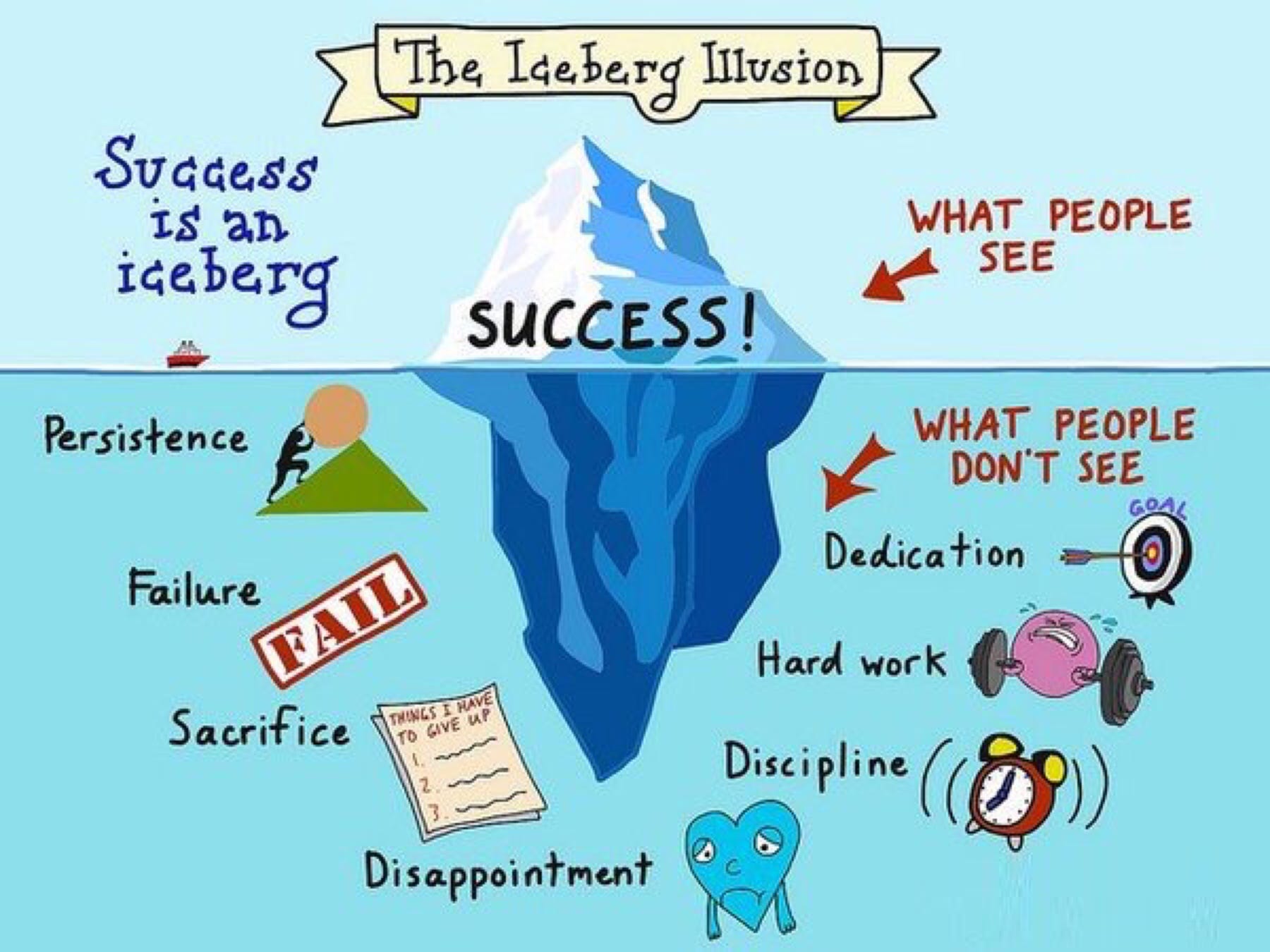
[It seems that rejections are common to everyone, even the highest esteemed scholars get them despite their obvious wisdom and knowledge. My friends shared some good advice and resources that help to bounce back from rejection. First off: upward and onward, as simple as it sounds, it works ... once you have managed to soften the feeling of a work being rejected. The process is to reflect, look at the feedback (or if they did not send any, ask for all the feedback, of course, anonymized), and rewrite and resubmit. Next, a great article in Medium on The Iceberg Illusion, adding the picture here as well.]

But the above two rejections just made me realize once more that I am not a traditional academic and as such, I doubt whether I can ever be part of the whole deal. Maybe this frequency of rejection is simply normal, but at present, I just feel I need to take another leap. Just like I did three times before. Maybe I am not made to gradually move forward? Maybe my thing is just this .... jumping ahead and then working on that 'new' concept until it becomes more mainstream.
[Feedback is an essential first step, next of course is to get going and to know thy self. And to repeat to yourself that critique is not personal, and it can be based on a number of reasons that do not even have to be immediately related to the work you did. In a way, emotion wins over ratio every time, but that does not mean we cannot rationalize after the first emotions have gone.]
Ciska sometimes tells me: "don't wine because you are living off the beaten track, even if you could walk the straight and narrow, you still would roll out your own route to get to the next place". Maybe she is right, but it does not make things easier. Maybe, it is never easy for any of us. Even for those who walk the more traditional roads to achieve a professional space in society. I don't know, but each time I get such a rejection, I just feel it's because of me, and it feels personal.
Okay, time to move forward again. Working on a project which combines human resources, AI and learning... fun, I must admit.
[and this is - and has always been - an inspiring Last Lecture]


Cartoon in this blogpost is from the fabulous Nick D. Kim - the http://www.lab-initio.com/ site

Friday, 4 January 2019

Call for Papers #CfP #AI #mLearning #MOOC in conferences #UNESCO @FedericaUniNa

January has started and three important calls for papers are coming up, all related to conferences. The three conferences are: eMOOCs2019 (on MOOCs), Mobile Learning week at UNESCO (focus on AI for development and mobile learning, and eLearning Africa (this year in Cote d'Ivoir), listed per deadline of the CfP.

Mobile learning week UNESCO (Paris, France): focus on AI for sustainable development
Call for proposals deadline: 11 January 2019
UNESCO Global AI Conference: Monday 4 March 2019
Policy Forum and Workshops: Tuesday 5 March 2019
Symposium: Wednesday 6 & Thursday 7 March 2019
Strategy labs & International Women’s Day: Friday 8 March 2019
Exhibits: Monday 4 to Friday 8 March 2019
More information: https://en.unesco.org/mlw/2019
UNESCO, in partnership with its confirmed partners – the International Telecommunication Union and the Profuturo Foundation – will convene a special edition of Mobile Learning Week (MLW) from 4 to 8 March 2019, at the UNESCO Headquarters building in Paris (France). The five-day event, under the theme ‘Artificial Intelligence for Sustainable development’ will start with the ‘Global Conference - Principles for AI: Towards a humanistic approach?’, followed by a one-day Policy Forum and Workshops, a two-day International Symposium and a half-day of Strategy Labs. On 8 March, towards the close of MLW, participants will be invited to join the celebration of International Women’s Day, particularly a debate on Women in AI to be held in UNESCO Headquarters. During the entire week, exhibitions and demonstrations of innovative AI applications for education and more than 20 workshops will be organized by international partners and all programme sectors of UNESCO.
eMOOCs 2019 in Napels, Italy
Deadline CfP: 14 January 2019.
Conference date:  May 20 – 22, 2019
More informationhttps://emoocs2019.eu/call-for-papers/overview/
Description
The Higher Education landscape is changing. As the information economy progresses, demand for a more highly, and differently, qualified workforce and citizens increases, and HE Institutions face the challenge of training, reskilling and upskilling people throughout their lives, rather than providing a one-time in-depth education. The corporate and NGO sectors are themselves exploring the benefits of a more qualified online approach to training, and are entering the education market in collaboration with HE Institutions, but also autonomously or via new certifying agencies. Technology is the other significant player in this fast-changing scenario. It allows for new, data-driven ways of measuring learning outcomes, new forms of curriculum definition and compilation, and alternative forms of recruitment strategy via people analytics.

At the MOOC crossroads where the three converge, we ask ourselves whether university degrees are still the major currency in the job market, or whether a broader portfolio of qualifications and micro-credentials may be emerging as an alternative. What implications does this have for educational practice? What policy decisions are required? And as online access eliminates geographical barriers to learning, but the growing MOOC market is increasingly dominated by the big American platforms, what strategic policy do European HE Institutions wish to adopt in terms of branding, language and culture?

The EMOOCs 2019 MOOC stakeholders summit comprises the consolidated format of Research and Experience, Policy and Business tracks, as well as interactive workshops. Original contributions that share knowledge and carry forward the debate around MOOCs are very welcome.

eLearning AFrica - Abidjan - Cote d'Ivoir
Deadline CfP: February 22, 2019.
Conference date: October 23 - 25, 2019
More informationhttps://www.elearning-africa.com/programme_cfp.php
Description
The 14th edition of eLearning Africa, the International Conference & Exhibition on ICT for Education, Training & Skills Development, which will take place in Abidjan, Côte d'Ivoire from October 23 - 25, 2019 and is co-hosted by the Government of Côte d'Ivoire. 

A unique event, Africa’s largest conference and exhibition on technology supported learning, training and skills development, eLearning Africa is a network of leading experts, professionals and investors, committed to the future of education & training in Africa.

Read more about the eLearning Africa 2019 themeThe Keys to the Future: Learnability and Employability, and become involved in shaping the conference agenda by proposing a topic, talk or session here.
Register today to profit from our Early Bird Rate

About eLearning Africa
Founded in 2005, eLearning Africa is the leading pan-African conference and exhibition on ICT for Education, Training & Skills Development. The three day event offers participants the opportunity to develop multinational and cross-industry contacts and partnerships, as well as to enhance their knowledge and skills.
Over 13 consecutive years, eLearning Africa has hosted 17,278 participants from 100+ different countries around the world, with over 80% coming from the African continent. More than 3,530 speakers have addressed the conference about every aspect of technology supported learning, training and skills development.

Tuesday, 13 November 2018

#MOOC free report, event MOOC for refugees (w travel fund options) and #CfP eMOOC2019

Two interesting MOOC events coming up one focused on MOOCs for refugees, and one for all you out there involved in researching or experiencing MOOCs (the eMOOC2019 conference). 

Free MOOC report

Linked to the MOONLITE event, there is a free MOOC report (130 pages) on “Exploiting MOOCs for Access and Progression into Higher Education Institutions and Employment Market”
The report gives an overview of the goals of the project, the methodology, and finishes with the practical recommendations for using online courses to enhance access and progression into higher education and the employment market (for refugees). 

MOONLITE multiplier event (part of a EU Erasmus+ project)

The MOONLITE event supports learning without borders, practically it harnesses the potential of MOOCs for refugees and migrants to build their language competences and entrepreneurial skills for employent, higher education, and social inclusion. 

There are bursaries to help cover your travel expenses which you can apply for at the venue!
23-24 November, UNED (Madrid, Spain).
Friday November 23
15:20. Welcome (Timothy Read & Elena Barcena, UNED, Spain)
15:30-16:30. Presentation of the MOONLITE project and its outputs (Jorge Arús-Hita, UCM, Spain & Beatriz Sedano, UNED, Spain)
16:30-17:30. Open Education Passports and Micro Credentials for refugees and migrants (Ildiko Mazar, Knowledge Innovation Centre, Malta)
17:30-18:00 Coffee
18:00-19:00 Kiron Educational Model and Quality Assurance for MOOC-based curricula (María Bloecher, Kiron, Germany)
Saturday November 24
10:00-11:00:  Inclusive by design: how MOOCs have the potential to reach people in ways other online courses do not (Kate Borthwick, University of Southampton, UK)
11:00-12:00: A tool for institutions for quantifying the costs & benefits of Open Education (Anthony Camilleri, Knowledge Innovation Centre, Malta)
12:00-12:30 Coffee
12:30-13:30: Workshop on how to design a socially inclusive MOOC (Elena Martín- Monje & Timothy Read, UNED, Spain)
13:30. Farewell (Timothy Read & Elena Barcena, UNED, Spain)

See travel details, online registration and more info here. No attendance fee. Limited places. 
➢ Sign up here: https://goo.gl/forms/RXYWS8MiQgYqfLkC2 (to obtain attendance certificate, materials, coffee).
➢ Venue: C/ Juan del Rosal, 16 - 28040 Madrid. How to get there: Metro until the stop: “Ciudad Universitaria” + Bus “U” until
the stop: UNED-Juan del Rosal: http://www.ia.uned.es/llegar-etsii

Call for papers eMOOC2019

Dates: 20 - 22 May 2019 
Venue: University of Naples, Federico II in Italy

Important Dates:
16 Jan 2017: Paper submissions for Research Track.
24 Feb 2017: Notification of acceptance/rejection
20 Mar 2017: Camera-ready versions for Springer LNCS Proceedings and copyright form.

The Higher Education landscape is changing. As the information economy progresses, demand for a more highly, and differently, qualified workforce increases, and HE Institutions face the challenge of reskilling and upskilling people throughout their lives. The corporate and NGO sectors are themselves exploring the benefits of a more qualified online approach to training, and are entering the education market in collaboration with HE Institutions, but also autonomously or via new certifying agencies. Technology is the other significant player in this scenario. It allows for new, data-driven ways of measuring learning outcomes, new curriculum structures and alternative forms of recruitment strategy via people analytics.

MOOCs represent the crossroads where the three converge. Come to EMOOCs 2019 and explore the impact and future direction of open, online education on a social, political and institutional level.

The eMOOC summit has four tracks: research, business, policy and experience track.
At the MOOC crossroads: where academia and business converge

The Higher Education landscape is changing. As the information economy progresses, demand for a more highly, and differently, qualified workforce and citizens increases, and HE Institutions face the challenge of training, reskilling and upskilling people throughout their lives, rather than providing a one-time in-depth education. The corporate and NGO sectors are themselves exploring the benefits of a more qualified online approach to training, and are entering the education market in collaboration with HE Institutions, but also autonomously or via new certifying agencies. Technology is the other significant player in this fast-changing scenario. It allows for new, data-driven ways of measuring learning outcomes, new forms of curriculum definition and compilation, and alternative forms of recruitment strategy via people analytics.

At the MOOC crossroads where the three converge, we ask ourselves whether university degrees are still the major currency in the job market, or whether a broader portfolio of qualifications and micro-credentials may be emerging as an alternative. What implications does this have for educational practice? What policy decisions are required? And as online access eliminates geographical barriers to learning, but the growing MOOC market is increasingly dominated by the big American platforms, what strategic policy do European HE Institutions wish to adopt in terms of branding, language and culture?

The EMOOCs 2019 MOOC stakeholders summit comprises the consolidated four-track format of Research and Experience, Policy and Business. And will feature keynote speakers, round table and panel sessions as well as individual presentations in each track. The aim is for decision-makers and practitioners to explore innovative and emerging trends in online education delivery, and the strategic policy that supports them. Original contributions that share knowledge and carry forward the debate around MOOCs are very welcome.The number of HE institutions involved in MOOCs, and the numbers of courses and enrolled students, has increased exponentially in recent years both in Europe and beyond. One of the results of this growing MOOC movement is an increasing body of research evidence that positions itself within the established research communities in technology enhanced learning, open education and distance learning. Key trends that are accelerating HE technology adoption are blended learning design and collaborative learning as well as a growing focus on measuring learning and redesigning learning spaces, and, in the long-term, deeper learning approaches and cultures of innovation.

This track welcomes high-level papers supported by empirical evidence to provide a rigorous theoretical backdrop to the more practical approaches described in the experience track, and particularly invites contributions in the area of these key trends.

  • Learning Designs – blended learning, collaborative learning, learner-generated content, open textbooks, immersive learning, relating course and content to learning outcomes
  • Defining and Measuring learning – learning analytics, educational data mining, user behaviour studies, adaptive and personalisation studies, cognitive theories and deep learning
  • Technology – infrastructure and interface, tools and methods to provide learning at scale; tools and methods for assessment; tools and methods for data collection and processing; blockchain technology; AI + automated feedback

Submission of Papers
This is a one-step process, via direct submission of abstract and full paper.

Full paper: up to 10 pages including references

There will be official conference proceedings for this track and submissions will be handled through EasyChair.

The use of the supplied Springer template is mandatory: https://www.springer.com/it/computer-science/lncs/conference-proceedings-guidelines

Please remember to indicate the relevant Track when you submit your paper.

Proceedings

The Proceedings of the Research Track will be published by Springer in the Lecture Notes in Computer Science (LNCS) Series.
Submission of Work-in-Progress Short Papers

Short papers (up to 6 pages) are also accepted in this track, reflecting work in progress, for publication in Online proceedings with ISBN.

The use of the Springer template is mandatory:
https://www.springer.com/it/computer-science/lncs/conference-proceedings-guidelines

When submitting your paper, please indicate type of paper and track in the submission process.

Proceedings

The Work-in-Progress proceedings will be submitted to CEUR-WS.org for online publication. Outstanding short papers may be included in the Springer Proceedings.

Important dates:
25 February 2019: Short Paper submissions for Research Track.
25 March 2019: Notification of acceptance/rejection
29 April 2019: Camera-ready versions for online Proceedings with ISBN and copyright form

Thursday, 18 October 2018

Call for papers #CfP from #BJET & call for co-authoring book on #Philosophy #AI #humanmachine #interdisciplinary

The call for papers below is for authors researching 'human learning and learning analytics in the age of artificial intelligence' and is an action to celebrate BJET's 50th anniversary. But first ... the call for co-authors to realize a new Rebus book on the subject of Introduction to Philosophy series.


Seeking Authors & Editors for Introduction to Philosophy Series

The Rebus Community initiative Introduction to Philosophy series has grown tremendously, and a few books are nearing the final stages! Led by Christina Hendricks (University of British Columbia), the series includes eight volumes in total, ranging across themes. We are currently seeking faculty interested in contributing to the series by authoring chapters in the following books:
Epistemology
Aesthetics
Metaphysics
Social and Political Philosophy
Philosophy of Religion

See the full list of open and completed chapters.

Authors should have a PhD in philosophy and teaching experience at the first-year level. PhD students and candidates may also be considered as authors, or can contribute to the book in other ways. If you are interested, please let us know in Rebus Projects. Include your CV, a brief summary of your experience teaching an intro to philosophy course, and the chapters you would like to write.

We’re also looking for a co-editor for the Aesthetics book, and an editor forPhilosophy of Science. If you’re interested in taking on one of these roles, read the full job posting and then comment in the activity on Rebus Projects, including some details about your experience and the area in which you are interested.

The editorial team encourages contributions from members of under-represented groups within the philosophy community. Decisions will be made by the team on a rolling basis.
Photo by Samuel Sianipar on Unsplash Reading source Mary Midgley, "Philosophical Plumbing" 

CfP for papers on the subject of Human learning and learning analytics in the age of artificial intelligence, a 50th anniversary edition of BJET

At the 50th anniversary of the Britisch Journal of Educational Technology (BJET) invites you to contribute your most current research to BJET as a way to celebrate BJET’s anniversary. Title of the special section: Human learning and learning analytics in the age of artificial intelligence (Critical perspectives on learning analytics and artificial intelligence in education)

Deadline for manuscript submissions: February 10th, 2019
Publication: Online as soon as copy editing complete.
Acceptance Deadline: 10th August 2019
Issue Publication: November 2019.
Guest editor: Andreja Istenič Starčič, Professor University of Primorska & University of Ljubljana; Visiting scholar University of North Texas. For all information, please contact: andreja.starcic@gmail.com

This special section focuses on human learning and learning analytics in the age of artificial intelligence across disciplines.

In May 2018, they organized a working symposium entitled The “The Human-Technology Frontier: Understanding the Human Intelligence 0.2 with Artificial Intelligence 2.0.” The symposium was sponsored by the Association of Educational Communications and Technology (AECT). Distinguished scholars, including learning scientists, psychologists, neuroscientists, computer scientists, and educators addressed some urgent questions and issues on the learner as a whole person, with healthy development of the brain, habit, behaviour, and learning in the fast-advancing technological world. The symposium inspired these special issue topics (which not limited to):

1. Learning and human intelligence: Based on what we know of the brain and what we are likely to understand in the near future, how should learning be defined/redefined?
2. Learning and innovation skills, the 4C - creativity, critical thinking, communication and collaboration: How could learning technologies support the transformative nature of learning involving all domains of learning, cognitive, psychomotor, affective-social? How could the advanced feedback and scaffolds support the transition from “combinational” to the “exploratory” and “transformational” creativity, thinking and potential consequences for communication and collaboration?
3. Towards a holistic account of a person – brain, body, habits, and environment: What would a learning and research design that embraces a whole person perspective look like?
4. Human intelligence with innovations and advances of technologies: What technologies are most likely to have a positive impact on learning in the short and long future?
5. Properties and units of measures of learning: What are the constructs of learning and beliefs about learners and learners’ needs given the multilevel technologies, collaborative networks, interaction and interface modalities, methodologies and analysis techniques we have to work with?
6. Learning perspectives: Do we face transitions in theories of learning?

In the past 50 years, BJET has been at the front offering a platform and forcing discussions in the above areas. At the 50th anniversary of BJET, we invite interdisciplinary scholars to contribute their most current research to BJET as a way to celebrate BJET’s anniversary.

Please send me the working title of your paper with a short abstract (if you include co-authors, please also provide names of all authors) to my e-mail andreja.starcic@gmail.com by November 30th, 2018.

For further information, please contact professor Andreja Istenič Starčič at andreja.starcic@gmail.com

Tuesday, 10 July 2018

3 Call for speakers/papers and Digital Learning Innovation Award (10.000$ faculty award!)

Learning Solutions conference organised by the ELearning Guild

Conference dates: 26 - 28 March 2019
deadline call for speakers: 27 July 2018
Submission portal: https://www.elearningguild.com/content/5527/learning-solutions-2019-conference--expo--call-for-proposals-form/ 
Venue: Orlando, Florida, USA

Learning Solutions 2018 is for training and learning professionals focused on the design, development, management, and/or distribution of technology-based learning, performance support, or blended solutions incorporating traditional training. The program supports the entire learning team, so regardless of your specific role, you’ll find the tools, technologies, ideas, strategies, and best practices for success. This event attracts people from around the world who want to keep up with the evolving needs of their learners.

Learning Solutions’ dedication to sharing proven examples in learning could help your team gain a stronger sense of what’s available and how you can put these tools and techniques into practice.
The Learning Solutions program is created by learning professionals. The program team comes from the fields of instructional design, eLearning development, and L&D leadership. They pride themselves on staying current with what matters most.
Experts will discuss the strategies and tools currently working in learning, and how they could impact your organization.
The practical, focused sessions will show you how to solve your team’s challenges and use today’s technology for new possibilities.

------------------------------------------------------------------------------------------------------
Future of Information and Communication Conference (FICC) 2019

Conference dates: 14-15 March 2019, San Francisco, USA
Deadline: 15 July 2018

Technically co-sponsored by IEEE
Please consider to submit your papers/posters/demo proposals for the Future of Information and Communication Conference (FICC) 2019 to be held from 14-15 March 2019 in San Francisco, United States.

FICC 2019 aims to provide a forum for researchers from both academia and industry to share their latest research contributions and exchange knowledge with the common goal of shaping the future of Information and Communication.
The conference programme will include paper presentations, poster sessions and project demonstrations, along with prominent keynote speakers and industrial workshops.

Important Dates
Paper Submission Due : 15 July 2018
Acceptance Notification : 01 August 2018
Author Registration : 15 August 2018
Camera Ready Submission : 15 September 2018
Conference Dates : 14-15 March 2019

Complete details are available on the conference website : http://saiconference.com/FICC
--------------------------------------------------------------------------------------------------------------------------------

Online Learning Consortium: Digital Learning Innovation Award (DLIAward) 


The portal is open for submissions until 31 July 2018.

The DLIAward  program recognizes faculty-led teams and institutions for advancing undergraduate student success through the adoption of digital courseware. OLC is calling for submissions from accredited U.S.-based institutions in two categories:
  • Institutional Award – $100,000 (up to three awarded)
  • Faculty-led Team Award – $10,000 (up to 10 awarded)
We ask that only those who are serious about truly being innovative, creative, and dedicated to changing the world of digital learning apply for this award. Missed the information session? You can register to watch the archive.
All applications must be submitted through the online submission portal. Winners will be announced at the OLC Accelerate conference, Nov. 14-16 in Orlando, Florida.
Visit the website for full details regarding the award competition.
-----------------------------------------------------------------------------------------

9TH INTERNATIONAL CONFERENCE ON LEARNING ANALYTICS & KNOWLEDGE - LAK

Learning Analytics to Promote Inclusion and Success

4-8 March 2019, Tempe, Arizona

Deadline for submissions: 1 October 2018
Visit the conference website for more information and submission details.

The 2019 edition of the international conference on Learning Analytics & Knowledge will take place in Tempe, Arizona, USA. LAK19 is organised by the Society for Learning Analytics Research (SoLAR) and hosted by Arizona State University.
We take learning analytics to be the measurement, collection, analysis and reporting of data about learners and their contexts, for purposes of understanding and optimising learning and the environments in which it occurs. We extend invitations to researchers, practitioners, educators, leaders, administrators, government and industry professionals interested in the field of learning analytics and related disciplines.
LAK19 will place particular emphasis on exploring ways in which institutions around the globe are advancing the state of learning analytics in order to promote inclusion and success. Arizona State University, the host institution for LAK19, proclaims in its charter that ASU is ‘measured not by whom it excludes, but by whom it includes and how they succeed’.  Learning analytics play a significant role at many institutions in helping to promote these values. 
Thus the special theme of this edition of the conference will be on ways in which learning analytics can be used to promote inclusion and success. We define inclusion broadly and this definition may cover the engagement of marginalised groups, groups who have not been as successful as others at achieving educational success, learners who find their current curriculum either too challenging or not sufficiently demanding, or other forms of inclusive inquiry. It may also address issues of accessibility in terms of educational opportunities and learning analytics. Success is also defined broadly and may be viewed from the perspective of learners, educators, institutions or society more broadly.
We welcome theoretical, methodological, empirical and technical contributions to all fields related to learning analytics. Related to our special theme the following topics are of particular interest:
  • Universal design for learning promotes an inclusive approach to the curriculum – how can learning analytics support curriculum design and revision from this perspective?
  • How can analytics be applied in ways that support inclusion and success?
  • How can the training of data scientists be made more inclusive?
  • What does educational success look like, and how can it be supported?
  • How can systematic biases (e.g. related to diversity) in our analytics algorithms be identified, reflected, and possibly avoided?
LAK19 will use a double-blind peer review process for the submissions. It is a LAK policy that submissions will only be considered for the category that they were originally submitted to, and there is no downgrading of papers. However, our timeline allows for rejected papers to be resubmitted in revised form as posters, demos, or individual workshop contributions. Accepted full and short research papers will be included in the ACM proceedings, as in previous years. Other accepted submissions will be published in the open access Companion Proceedings, archived on the SoLAR website.

Important Dates

All deadlines are 23:59 GMT-11
Submission deadline for main track categories (Research, Practitioners, Workshops, Tutorials and Doctoral Consortium)1 October 2018
Notification of acceptance for Workshops and Tutorials15 October 2018
Workshop Calls for Participation29 October 2018
Notification of acceptance for Research, Practitioners, Doctoral Consortium19 November 2018
Submission deadline for Posters/Demos and Workshop Papers3 December 2018
Camera-ready papers for ACM Proceedings: Full Research Papers and Short Research Papers17 December 2018
Notification of Acceptance for Posters/Demos and Workshop Papers4 January 2019
Early-bird registration closes8 January 2019
LAK19, Tempe, Arizona4-8 March 2019

Tuesday, 20 February 2018

Call for proposals: 8 conferences and workshop #CfP #elearning #mlearning


This is a Call for Papers delight! It seems that an array of inspiring conferences is open for proposals, workshops, doctoral consortium options. Listed below are one workshop on Artificial Intelligence and Ethics, six academic conferences (mLearn conference in Chicago, , the ECTEL conference in Leeds, UK, the Australian International Education Conference (AIEC) in Sydney, Australia, IAU global university partnerships, Kuala Lumpur, Malaysia, EdMedia in Amsterdam, Netherlands, the Alt-C conference in Manchester, UK) and two grand elearning conferences (mixing academia, policy and corporate): DevLearn in Las Vegas, USA and Online Educa Berlin (OEB) in Berlin Germany.

mLearn2018 – International Mobile Learning conference
Where: Concordia University, Chicago, USA
When: 11 – 14 November 2018
Deadline for proposals: 30 April 2018
General theme and description
Mobilized Learning: Pedagogical and Technological Innovation for Teaching & Learning
mLearn is the leading international conference on mobile and contextual learning and attracts participants annually from more than 60 countries. mLearn 2018 provides a forum for researchers, policy makers, professionals and educators from higher education, school education and vocational education, government departments, industries and international organisations as well as IT developers and solutions providers to share knowledge, research and practices and debate critical issues pertaining to sustainable futures for mobilized learning.

EC-TEL – European Conference on Technology Enhanced Learning
Where: University of Leeds, UK
When: 3 – 6 September 2018
Deadline for abstracts: 15 April 2018 (with statement of Open Science!)
General theme and description
‘Lifelong technology enhanced learning: Dealing with the complexity of 21st century challenges’.
We live in an increasingly digital and globalized world that offers great opportunities for information sharing and the generation of new knowledge. This reality has enabled us to move forward rapidly as a society in many respects, but has also led us to complex, diverse and interdisciplinary challenges that affect all areas of knowledge such as health, demographic change and wellbeing; food security and bio-economy; secure and clean energy; smart and green energy; or climate action and environment - to name just a few that are emphasized by the European Union.

Australian International Education Conference (AIEC)
Where: Sydney Conference Centre, Sydney, Australia
When: 9 – 12 October 2018
Deadline for proposals:9 – 12 October 2018
General theme and description
The theme is 'empowering a new generation' and the program will feature world leading experts, unique social events and an exhibition, all hosted in and around the new Sydney Convention Centre, ICC Sydney.
With over 1300 attendees, AIEC 2018 will once again be the leading event on the international education calendar in Australia.

Higher Ed Partnerships for Social impact - IAU International Conference
Where: Kuala Lumpur, Malaysia
When: 13 – 15 Nobember 2018
Deadline for proposals: 3 April 2018
Call for cases: https://etouches-appfiles.s3.amazonaws.com/html_file_uploads/359a2a74df239ceb38058b89d2a040c5_Callforcasestudies.pdf?response-content-disposition=inline%3Bfilename%3D%22casestudies2018%22&response-content-type=application%2Fpdf&AWSAccessKeyId=AKIAJC6CRYNXDRDHQCUQ&Expires=1519126805&Signature=z%2F34LHX4LaVnayZo7CpkoKNo3TY%3D
General theme and description
The conference will address the theme ‘Higher education partnerships for societal impact’.
IAU believes that higher education institutions (HEIs) play an important role in the development of societies. Higher education institutions engage with society in a variety of ways. Partnerships with civil society, the private sector, the local authorities and decision-makers or between HEIs take on numerous forms and shapes. IAU invites its Members, the global higher education communities, and their partners to reflect on and discuss their mandate and social responsibility, while presenting different forms of partnerships adopted around the world and for what societal impact. The conference will also be a venue to discuss the challenges and obstacles related to this mission.
Call for case studies
Several breakout sessions will show-case examples of partnerships from around the world between higher education institutions and different partners (civil society, the private sector, local authorities etc.). If your institution is pursuing partnerships for societal impact and you wish to show-case your experience during the conference, please send a short description of the partnership and its purpose to IAU.

EdMedia
Where: Amsterdam, Netherlands
When: 25 – 29 June 2018
Deadline for proposals: 9 April 2018
General theme and description
Innovation and Education
EdMedia + Innovate Learning, the premier international conference in the field since 1987, spans all disciplines and levels of education attracting researchers and practitioners in the field from 70+ countries.
This annual conference offers a forum for the discussion and exchange of research, development, and applications on all topics related to Innovation and Education.
EdMedia + Innovate Learning is an international conference organized by the Association for the Advancement of Computing in Education (AACE)

Alt-C
Where: Manchester, UK
When: 11 – 13 September 2018
Deadline for proposals: 8 March 2018
General theme and description
Will you be a part of it?
For ALT’s 25th Annual Conference we will bring together different critical perspectives in Learning Technology from across our community that will examine the challenges ahead and question the shape of things to come. Will you be a part of it? This is your invitation to make your contribution to our 25th year as the UK’s leading professional body in Learning Technology

Workshop Ethics for Artificial Intelligence
Where: University College London, UK
When: 30 June 2018
Deadline for proposals: 30 April 2018
Call for abstracts (sending via email): https://aiedethics.wordpress.com/join-us-get-involved/
General theme and description
Ethics in AIED
The field of AIED raises far-reaching ethical questions with important implications for students and educators. However, most AIED research, development, and deployment have taken place in what is essentially a moral vacuum (for example, what happens if a child is subjected to a biased set of algorithms that impact negatively and incorrectly on their school progress?).

OEB – Online Educa Berlin
Where: Berlin, Germany
When: 5 – 7 December 2018
Deadline for proposals: 30 April 2018
More info: https://oeb.global/
General theme and description:
Learning to Love Learning!
OEB, incorporating Learning Technologies Germany, is the global, cross-sector conference on technology supported learning and training. Shape the agenda of the 24th edition of OEB by proposing a topic, talk or session under the overall theme “Learning to Love Learning”: Technology is changing society. The way we live and the jobs we do will never be the same again. In twenty years, the world of work will be unlike anything we have ever known. The development of artificial intelligence will allow machines to replace workers in many industries on an unprecedented scale. Humankind will face some fundamental, existential questions. Why are we here? What are we doing? How are we different from the machines? Education will shape our response to the immense challenge of this new age. But education and training will have to change too. So will the nature of employment. Learning will no longer be a brief phase in life. It will become a central part of our existence. In an era of constant and increasing change, we will discover a new appreciation of learning and an understanding of its place in the future. We will learn to love learning. At its 100+ sessions and at the exhibition, the conference will bring you to the forefront of learning and technology developments, give you new insights on opportunities and challenges that are changing the world of learning, show you the latest best practice from leading organisations and allow you to meet, discuss and network with more than 2,000+ international learning professionals from the workplace learning, education and public service sectors.

DevLearn
Where: Las Vegas, USA
When: 24 – 26 October 2018
Deadline for proposals: 9 March 2018
General theme and description
Developing Learning
DevLearn Conference & Expo, North America’s leading event focused on learning technologies, is where the entire industry gathers to share and learn about innovative thinking and emerging technologies, explore the possibilities they present, and define how they can drive innovation within our industry … our organizations … and our learning. It is the place where you can meet with industry thought leaders, share strategies with colleagues, discover best practices, and learn about the hottest topics and ideas for learning. Join the community of industry pioneers that is defining the future of training and performance!