Showing posts with label funding. Show all posts

Tuesday, 19 February 2019

Just sharing a few rejections: paper & funding, and solutions #academicLife #life #loveMyNetwork


Life can be hard, both personally and professionally, yet at the same time life can simply push you towards a more pleasant option along the way, seemingly using rejections to get you on to the right track. I sure hope this will be the case, but only hindsight will tell. [addition one day after writing this post: while sharing these ideas on Facebook, I got such an inspiring response from my network, I decided to add the ideas and remarks they had below, between square brackets]
Today I was informed that my co-authored paper for the eMOOC summit 2019 in Naples was rejected. Rejections rarely result in joy, and this was no exception. For some reason writing a paper is also a personal effort. You try with all your ability (and mostly under a bit of time pressure) to come up with a paper that shares your research in just a few pages. Referencing to prior great minds in your field of expertise. So, when a paper gets rejected, it simply hurts. It feels personal to some extent.
The rejection came one week after my submission to get a prestigious Marie Curie Fellowship got rejected as well, it did not get the threshold. The review did have a lot of positive points though (which did soften the blow). Granted, I wrote this submission as a plan B in order to increase my options to get back to work after I recovered from the year rehab after the cancer diagnosis. I put my heart into it, not only me but also the professor who was willing to employ me in his department if the fellowship was successful. Luckily, I was able to get back to work and on good terms, and on an inspiring project.
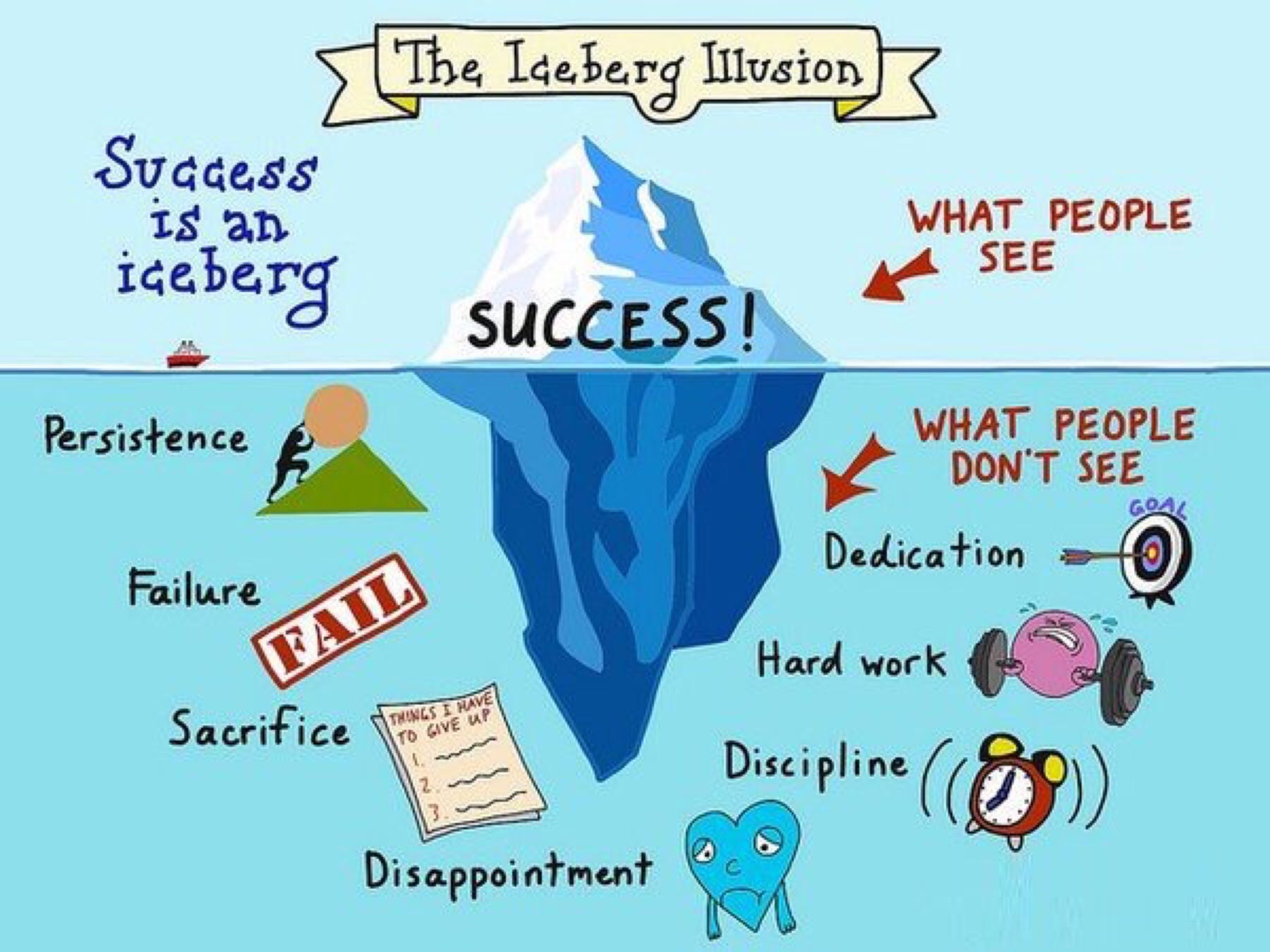
[It seems that rejections are common to everyone, even the highest esteemed scholars get them despite their obvious wisdom and knowledge. My friends shared some good advice and resources that help to bounce back from rejection. First off: upward and onward, as simple as it sounds, it works ... once you have managed to soften the feeling of a work being rejected. The process is to reflect, look at the feedback (or if they did not send any, ask for all the feedback, of course, anonymized), and rewrite and resubmit. Next, a great article in Medium on The Iceberg Illusion, adding the picture here as well.]

But the above two rejections just made me realize once more that I am not a traditional academic and as such, I doubt whether I can ever be part of the whole deal. Maybe this frequency of rejection is simply normal, but at present, I just feel I need to take another leap. Just like I did three times before. Maybe I am not made to gradually move forward? Maybe my thing is just this .... jumping ahead and then working on that 'new' concept until it becomes more mainstream.
[Feedback is an essential first step, next of course is to get going and to know thy self. And to repeat to yourself that critique is not personal, and it can be based on a number of reasons that do not even have to be immediately related to the work you did. In a way, emotion wins over ratio every time, but that does not mean we cannot rationalize after the first emotions have gone.]
Ciska sometimes tells me: "don't wine because you are living off the beaten track, even if you could walk the straight and narrow, you still would roll out your own route to get to the next place". Maybe she is right, but it does not make things easier. Maybe, it is never easy for any of us. Even for those who walk the more traditional roads to achieve a professional space in society. I don't know, but each time I get such a rejection, I just feel it's because of me, and it feels personal.
Okay, time to move forward again. Working on a project which combines human resources, AI and learning... fun, I must admit.
[and this is - and has always been - an inspiring Last Lecture]


Cartoon in this blogpost is from the fabulous Nick D. Kim - the http://www.lab-initio.com/ site

Tuesday, 14 June 2016

Free bidding for funding seminars for early researchers #PhD #EU #funding

While I am nearing the end of my PhD journey (which is basically: 'type until you drop' and 'what do you mean there is an outside world with real people?'), I am now confronted with: what happens next. I am lucky to have some options (one as a pedagogical adviser which I like), and I also applied for a Marie Curie-Sklodowska fellowship (a highly acclaimed 3 year academic scholarship). But to be honest funding is a main issue for any academic. Which is why I am happy that the KMI (Knowledge Media Institute of The Open University) has made two free webinars available which focus on the act of bidding for funding. Including why you should apply as well as how.

The bidding for funding seminars are aimed at doctoral students as well as early researchers, so an interesting and timely mix. Gladly sharing the description:

"The Bidding for Funding: Opportunities for Students workshop aims to provide an overview of some of the major sources of funding for research and knowledge transfer within UK and EU available to postgraduate research students. It will deal with funding to support their phd projects as well as looking at opportunities to support their research beyond their phd.  Dr Hitesh Patel will provide an overview. The workshop will also provide an opportunity to hear from Dr Sam Eden in the Dept of Physical Sciences, Science Faculty. Dr Eden will share his experience of securing external funding through a range of schemes to develop their academic career. He currently holds an EPSRC Accelerator Fellowship and also had funding from an EU Marie Curie Fellowship. There may also be an opportunity to hear from a PhD student and learn from them about how they have gone about sourcing funding for their phd project. The workshop will cover topics such as:
  • OU support for seeking external funding and sourcing funding opportunities
  • major sources of UK and EU funding
  • submitting proposals
  • developing external funding bids – opportunity to look at some successful and unsuccessful proposals and discuss and review these
  • questions and answer
Select from replays below to look at the recordings (approx 50 min).
10:00 am Dr Hitesh Patel
11:00 am Dr Sam Eden

Thursday, 17 September 2015

Liveblog #Ectel2015 keynote Juan Pelegrin EU #funding #Edtech

Okay, this blog might be of important for anyone searching for funding regarding EdTech skills. Juan Pelegrin seems like an honest believer in funding projects to get change done.

first part from Doug Clow's liveblog
"Digital skills shortage. Mismatch of rising unemployment, with 1m vacancies not filled. Have to modernise education and training systems, cheaply and effectively. Cost-saving a priority. The OECD report on Thursday, where the conclusions were misread to say digital technologies do not help learning. Not good news, we will have to prove them wrong."

Barriers
Limited uptake of ict is schools and unis
Fragility of current EU learning tech industry

Opportunities
  • Tech is disrupting education (moocs, cloud, tablets, interactive books)
  • Changes in education – open, flexible access t learning and education 24/7
  • Demands for 21st century skills
  • Build European market for interactive digital content for use in learning (remark Inge interesting, might be integration of MOOCs in schools)
Challenges
  • Promote excellence in education and skills through pervasive access to digital learning and 21st century skills
  • Ensure adequacy between skills and employment market (remark Inge: interesting focus still on job creation, where jobs are bound to disappear through increased automation)

Support to a triple play: innovation, inclusion, and economic impact

Digital tech in EU
  • In EU education is failing to keep pace with digital society and economy
  • 63% of nine year olds do not study at highly digital schools
  • Teachers feel insecure about working with tech.
Gunther Oettinger – commissioner for digital economy and society
Mission: (interest!) “… to reinforce digital skills and learning across society, with a view to empowering EU workforce and consumers for the digital era”
This is new to EU, a focus on digital skills. The EU has put real political attention on this topic (feeling funding opportunities here

Recent EU actions
  • Digital single market initiative (2015)
  • Initiative opening up education (2013)
  • Grand coalition for ICT jobs (2013)
  • Research and innovation on ICT for learning: close to 40 projects, ne calls under H2020 contributing to shape the future of education and training (remark: look for calls)
An overview of funding is given… but … the question is of course (in my opinion) which type of funding of projects has had which type of objective impact (objective meaning: not-self reported, but established from outside findings).

Outcome Topic 20: tech for better human learning and teaching WP 2014-2015
Input: 174 proposals for 640 million funds
Output: only 54 proposals ranked as high quality, 12 retained (as many calls were resubmissions trying to fit into other calls), 5 were put on the reserve list.
(remark: this makes it possible if you write a high quality call to get funding: make it new, authentically fitting the call…)

Outcome Topic 20: Coverage
  • Good coverage overall with wide reach of learning contexts from formal to informal (schools, universities, VET, workplace, social learning).
  • Advanced personalisation and adaptivity through robotics, AI, immersive environments, wearable tech, analytics)
  • Key areas target STEM, artistic expression, languages, open courseware, assessment, career development skills and skills for industry 4.0.
  • Special needs widely recognised
  • No PPI submission (PPI? Lite umbrella – not sure what this means, need to look up)
Horizon 2020 work programme 2016 – 2017
ICT 22 2016 can be found on page 53 of the Horizon 2020 report.
  • ICT 22 2016 tech for learning and skills (30 -  20 million EUR – if I heard correctly and looking for proposals around 5 million – WHAT?! Well, just an indication)
  • Focus on developing open and interoperable components
  • Digital learning infrastructure
  • Personalised learning
  • Skills validation
  • Assessment of learner’s progress
  • Availability and wider adoption of education tech
  • Efficient and effective learning
  • Very large pilots in several European countries (very large: scalable across countries, schools, organisations… so deployment of tech)
Wise advise: read the call, and stick to the suggestions.
Primary and secondary schools only = focus

Other option for funding: focus on Research and Innovation Action
  • Tech to focus on Science, Tech, Engineering, Mathematics, combined with Arts (STEAM) – remark Inge: seems good bet, as art always led STEM innovations, think Einstein visualisation capacity)
  • Develop creativity
  • Foundational research and piloting
  • Potential impact on key growth areas
Competition remains to be very high, so if you answer a call, do it at high quality. “Half of the project evaluators sit in this room” 
16 April 2016 will be deadline
Look for good, strong partners (Lisa?)
Interpret the language of the text as it is (and/or means and/or). 

Additional information: there are billions of EUR for professional development (local initiatives) of teachers in schools... so make bid. This is apart from the above, just a note to take into consideration of CPD of teachers is in your mind. See EU structural funds. 

Friday, 15 November 2013

Call for #papers & pre/postdoctoral #Fellowship in Japan

Great news this morning, an interesting funding opportunity (travel cost, residency, settling in) for people residing in the UK, but having a European, Canadian, American or British nationality and looking for a collaboration with research institutes in Japan. The program is open to researchers from all departments (including social sciences). It is a short-term option, which - to me - makes it even more appealing (explore, evaluate and grow). More information on the fellowship can be found here.

From the funding organization website:
This Programme provides the opportunity for short-term visits for pre- and post-doctoral UK researchers and researchers from Europe and North America based in the UK to conduct cooperative research with leading research groups at Japanese Universities and Institutions. The Programme is designed to provide researchers with first-hand experience of the research and living environment in Japan, whilst expanding academic exchange between Japan and the United Kingdom. Researchers from all fields of sciences including humanities and social sciences are eligible to apply. Awards will cover visits of 1 to 12 months.

Calls for paper:

M4D (mobile for development) in Dakar, Senegal
When: 8 - 9 April 2014 
submission deadline 1 December 2013 (this is the extended deadline)
More information for the call of papers: 
Overall information on the conference: http://mobilemondaydakar.org/m4d2014/en/

Call for paper on Special Issue: New Media and Social Learning
Website: http://www.mdpi.com/si/socsci/social_learning
Guest Editor: Prof. Dr. GrĂ¡inne Conole
Deadline for manuscript submissions: 30 April 2014

You may send your manuscript now or up until the deadline.
Submitted papers should not have been published previously, nor be under consideration for publication elsewhere. We also encourage authors to send us their tentative title and short abstract by e-mail for approval to the Editorial Office at:
socsci@mdpi.com.

This Special Issue will be fully open access. Open access (unlimited and free access by readers) increases publicity and promotes more frequent citations as indicated by several studies. Open access is supported by the authors and their institutes.
More information is available at http://www.mdpi.com/about/openaccess/.

The Article Processing Charges (APC) will be waived for well prepared manuscripts. However, a fee of 250 CHF may apply for those articles that need major editing and formatting and/or English editing.
For details see: http://www.mdpi.com/about/apc/. 

Please visit the Instructions for Authors before submitting a manuscript:
http://www.mdpi.com/journal/socsci/instructions/.
Manuscripts should be submitted through the online manuscript submission and editorial system at http://www.mdpi.com/user/manuscripts/upload/.

Social Sciences (ISSN 2076-0760) is an international, peer-reviewed, quick-refereeing open access journal (free for readers), which publishes works from extensive fields including anthropology, economics, law, linguistics, education, geography, history, political science, psychology, sociology and so on. Social Sciences is published by MDPI online quarterly.

MOBILITY 2014, The Fourth International Conference on Mobile Services, Resources, and Users
July 20 - 24, 2014
 - Paris, France
Submission deadline: February 28, 2014
  • regular papers
  • short papers (work in progress)
  • posters
Submission page: http://www.iaria.org/conferences2014/SubmitMOBILITY14.html
Sponsored by IARIA, www.iaria.org

Monday, 25 July 2011

Help us #save new born babies lives by using #mobile devices for #ultrasound

"Why not save the lives of new borns by making use of mobile devices that can be used for ultra-sound?" with this simple idea my wonderful and inspiring colleagues Vincent De Brouwere and Fabienne Richard started a quest to get a new mobile project up and running.

The project is now before a jury and it would be wonderful if as many people as possible could vote in favor of this proposal, as it will really save lives of new born babies and their mothers.

If we get enough votes, the project will be funded by the Belinda and Bill Gates foundation. Please feel free to support us by voting on the project (here is the link to the voting option), Remark: you must register here first (for free) to be able to vote, it only takes a moment and I think they do it to make sure the voters are 'real' people. You vote by first registering for an account, than signing in and clicking on the 'star' next to the project of your choice. Thanks in advance!

This is what the project is all about:

Title of the project: UltraSound4Africa
Organization:Institute of Tropical Medicine - Antwerp
Organization Location: Antwerp, Belgium

Optimal care during childbirth in rural areas of most low and middle income countries is hampered by 2 major problems: the limited equipment and capacity of health workers for diagnosis, and the quasi-absence of back-up from the hospital, which impacts on their motivation and competence. In order to improve the technical quality of care and the motivation of primary care maternity staff working in rural areas of low-income countries, the Ultrasound4Africa project proposes to develop a two-pronged integrated intervention:

  • the provision of low cost smartphone-based ultrasound imaging systems (MobiUS device) that connect rural maternities with specialists. This telemedicine intervention aims at early diagnosis of life threatening obstetric complications, appropriate case management and rapid referral of critical cases to the hospital.
  • The development of a network of primary care maternities with their referral hospitals, aiming at providing technical and moral support to health workers working in remote areas.

The pilot test will be implemented in rural maternities of 2 districts in Burkina Faso and Mali where access to Emergency Obstetric Care (EmOC) remains low despite a national policy of abolition of user fees for EmOC. This intervention is expected to improve utilization of antenatal care and skilled birth attendance by increasing women’s trust in primary care services and to contribute to reducing maternal and newborn mortality and morbidity. Ultrasound4Africa will be implemented by national teams at district level and supported by a multidisciplinary team (clinicians, public health specialists and IT specialists) with an extensive experience in sub-Saharan Africa.


Thursday, 10 February 2011

Vleva Europe: eLearning the grand challenge, some ideas that were mentioned and funding tips


Interesting tip: Vleva funding guide: 'uw snelweg naar Europese subsidies: contact subsidieteam (at) vleva (dot) eu of 02/7371430 of via website: www.vleva.eu/subsidiewijzer/

(Gode)lieve van den Brande (ICT and education, spec. lifelong learning, funding possibilities)
godelieve (dot) van-den-brande (at) ec.europa.eu

Lieve is a presenter who directs herself only to one part of the audience (on her right side), but she is a fluent speaker. She wears a nice green dress and she will share her presentation afterwards (I will keep you posted once it is shared).

The text below is part of live blogging, so it might be a bit rough on the edges (rapid, live typing).

points out the shift towards Learning Society, she says the learners are pushing the shift towards the digital world.
Mentions the 'new millennium learners': who are they, what are the competencies they need... close to 2020, for this also includes the skills we will need for our jobs.

The last 7 - 8 years there was a decline in eLearning initiatives, because educational institutions could not attain the expectations from research. She says that ICT is not yet been absorbed by teaching and learning.
It is not because someone is a digital literate, it will also be an effective learner. She pushes the idea that it is the task of the educational institutions and schools to teach the learners how to get the newly needed competencies and in order to do this, the teachers need to alerted, need to be motivated to get into it as well.

Like her e-maturity approach for schools, institutes and teachers. And she emphasizes crucial importance of teacher skills development.

She gives the European Policy Framework overview, which triangulates research, innovation and education. She also mentions the Europe2020 plans for education.

She emphasizes: leadership and institutional change, digital competences, professional development, learner-centered approaches.

2015 huge need of eLearning (65% ?), competent people - yes this is the future, (note from myself: if you are looking for a job, re-school yourself to become digital competent, and get your profile out there).

digital competencies are currently not in the curricula, so how are we going to fix this? she asks.

A new policy agenda: Europe 2020
Education training is considered as a central pillar for future growth, social cohesion, competitiveness. In order to do this, we need to keep investing in the way education training happens, also in how the learning/teaching process can be innovated.
We need to attack: drop out, quality in education, equity in education. We need to see how member states take up these suggestions (these targets are not mandatory).

Digital literacy needs to be lifted for all. And we need to see how new technologies enhance the education for all.

She mentions that the universities, high schools are also not yet e-mature, similar in other training areas.

Looking for a generic model that would set up a roadmap for digital competence, in order to integrate it in curricula outcomes. Not mandatory, but suggested by EU.
Mentions peer-to-peer learning and says that the EU will make an effort to go further then counting the number of pc's in a class, but really go to capture the actual learning that is taking place in the classroom.

in 2020: strategic challenges: quality & efficiency: lifelong learning and mobility (equity and citizenship) and innovation and creativity (including entrepreneurship).

initiative taking, problem based learning, languages... having positive impact on learning and learning outcomes. We need to show it has that value in using digital competencies and exchanging that with each other.

Lifelong learning program: 2010: key activity 3 innovative practices and exchanges around the use of ICT in the Lifelong learning program! (deadline by the end of March). Go to the site to see the projects in this field and mainstreaming programs (also under Comenius and Erasmus).
(she also mentions eTwinning, but will be mentioned in the next post with Roger)

Wonders if there is occurring any learning in the informal learning environments like social media? Of course! But, the fact that she mentions this, could mean that projects with this in mind would have a bigger success to get funding.

She concludes with a clear request to share our - teachers, experts - thoughts with EU to collaboratively work towards 2020.

Friday, 27 August 2010

Interested in Grand Challenges in Global Health in combination with Low Cost cellphones? Let me know

In the past (and present) the Grand Challenges in Global Health from the Gates foundation have given rise to a great set of interesting projects. Interesting for these funds are only dedicated to really WILD projects that have a global impact.

Next Friday, there will be a brainstorm at my institute on possible projects for this Grand Challenge, for this is the second time that a call is launched which is also linked to low-cost cellphone solutions. Most of the people in this first brainstorm will be physicians, so we will try and locate areas that are in dire need for a medical solution that involves the use of technology. The Institute of Tropical Medicine (ITM) where I work is a leading institute for HIV/AIDS and we are involved in many international projects, so medical expertise is assured.

In a second phase we will try and work out the WILD technological solution involving low-cost cellphones.

If any of you with expertise in mobile solutions are interested in getting into the technological brainstorming team (to jointly go for such a grand), let me know. We would love to get a collaboration going.

Topics for the call of Grand Challenges Explorations Round 6 are:
  • Design New Approaches to Cure HIV Infection;
  • Create the Next Generation of Sanitation Technologies;
  • The Poliovirus Endgame: Create Ways to Accelerate, Sustain and Monitor Eradication;
  • Create Low-Cost Cell Phone-Based Applications for Priority Health Conditions;
  • Create New Technologies to Improve the Health of Mothers and Newborns
Want to know more? Have a look at their website.

Thursday, 19 February 2009

Resource for mobile funding: mobile health projects overview from UN, Vodafone, Rockefeller Foundation


Thanks to the ever resourceful Adesina Iluyemi, an overview of mobile health projects came to me. If you are looking for funding in this area, this might be a good resource to get information and ideas from. If your projects builds on suggestions they give, your project might have more chances to be chosen.

This is a summary copied from HIFA 2015 mailing list.

The UN, Vodafone, and the Rockefeller Foundation's mHealth Alliance have launched a 'Mobile health' campaign, says a news item on the BBC website:

Science and technology reporter, BBC News, Barcelona - 17 February 2009
http://news.bbc.co.uk/1/hi/technology/7893849.stm

The UN/Vodafone Foundation Partnership aims to unite existing projects to improve healthcare using mobile technology, and will 'guide governments, NGOs, and mobile firms on how they can save lives in the developing world'.

'The partnership is now calling for more members to help in mHealth initiatives..."The biggest problem is fragmentation of small projects," says Ms Thwaites [head of UN/Vodafone Foundation Partnership]. "A lot of the work being done on the ground is NGO- and foundation-led, but let's join those efforts with the Microsofts and the Qualcomms and the Intels and the Vodafones. There's a business case for it now; you have to have the experience of the NGOs on the ground talking to the big corporates out there and creating real business models, and that's why I think the mHealth Alliance can tackle that."'

The Partnership has published a 'groundbreaking' mHealth for Development report, which is available at:
http://www.bjhcim.co.uk/documents/mHealth_for_Development.pdf

The second half of the report contains descriptions of more than 50 projects ranging from eLearning, HMIS, telemedicine and patient-centric applications.

Thursday, 7 February 2008

FP7 - projects


There is another ICT call (call 3) open for FP7 projects and some rumours going around at ITM trying to get solid projects going.

A lot of interesting thoughts going around but as always - and as mentioned by the all knowledgeable Sean McCarthy of Hyperion: the budget and the ethics questions are always underestimated, yet crucial in a project proposal. A few of the researchers at ITM are really busy to get the content and techniques going with partner institutions, but ... we will ask outsiders to look into the proposals and look at the solidity of the budget and ethics.
Another forté for future projects is the incorporation of new European countries as project partners.

If any of you out there are interested in getting an FP7 proposal together, you might want to consider becoming an Cordis expert. If you are an expert in your field, you can offer yourself as an expert to evaluate proposals (not your own proposals of course), that way you can see the research that is done in your field, get an idea of the strong players. This in its turn will get you into a better starting position to launch future bids.
So if you did not register as a possible Cordis expert, get cracking at: Cordis expert.

If you have strategic ideas in how to tackle FP7 projects, feel free to comment and add, looking forward to an exchange of strategies (or possible future partnerships).