Showing posts with label papers. Show all posts

Tuesday, 19 February 2019

Just sharing a few rejections: paper & funding, and solutions #academicLife #life #loveMyNetwork


Life can be hard, both personally and professionally, yet at the same time life can simply push you towards a more pleasant option along the way, seemingly using rejections to get you on to the right track. I sure hope this will be the case, but only hindsight will tell. [addition one day after writing this post: while sharing these ideas on Facebook, I got such an inspiring response from my network, I decided to add the ideas and remarks they had below, between square brackets]
Today I was informed that my co-authored paper for the eMOOC summit 2019 in Naples was rejected. Rejections rarely result in joy, and this was no exception. For some reason writing a paper is also a personal effort. You try with all your ability (and mostly under a bit of time pressure) to come up with a paper that shares your research in just a few pages. Referencing to prior great minds in your field of expertise. So, when a paper gets rejected, it simply hurts. It feels personal to some extent.
The rejection came one week after my submission to get a prestigious Marie Curie Fellowship got rejected as well, it did not get the threshold. The review did have a lot of positive points though (which did soften the blow). Granted, I wrote this submission as a plan B in order to increase my options to get back to work after I recovered from the year rehab after the cancer diagnosis. I put my heart into it, not only me but also the professor who was willing to employ me in his department if the fellowship was successful. Luckily, I was able to get back to work and on good terms, and on an inspiring project.
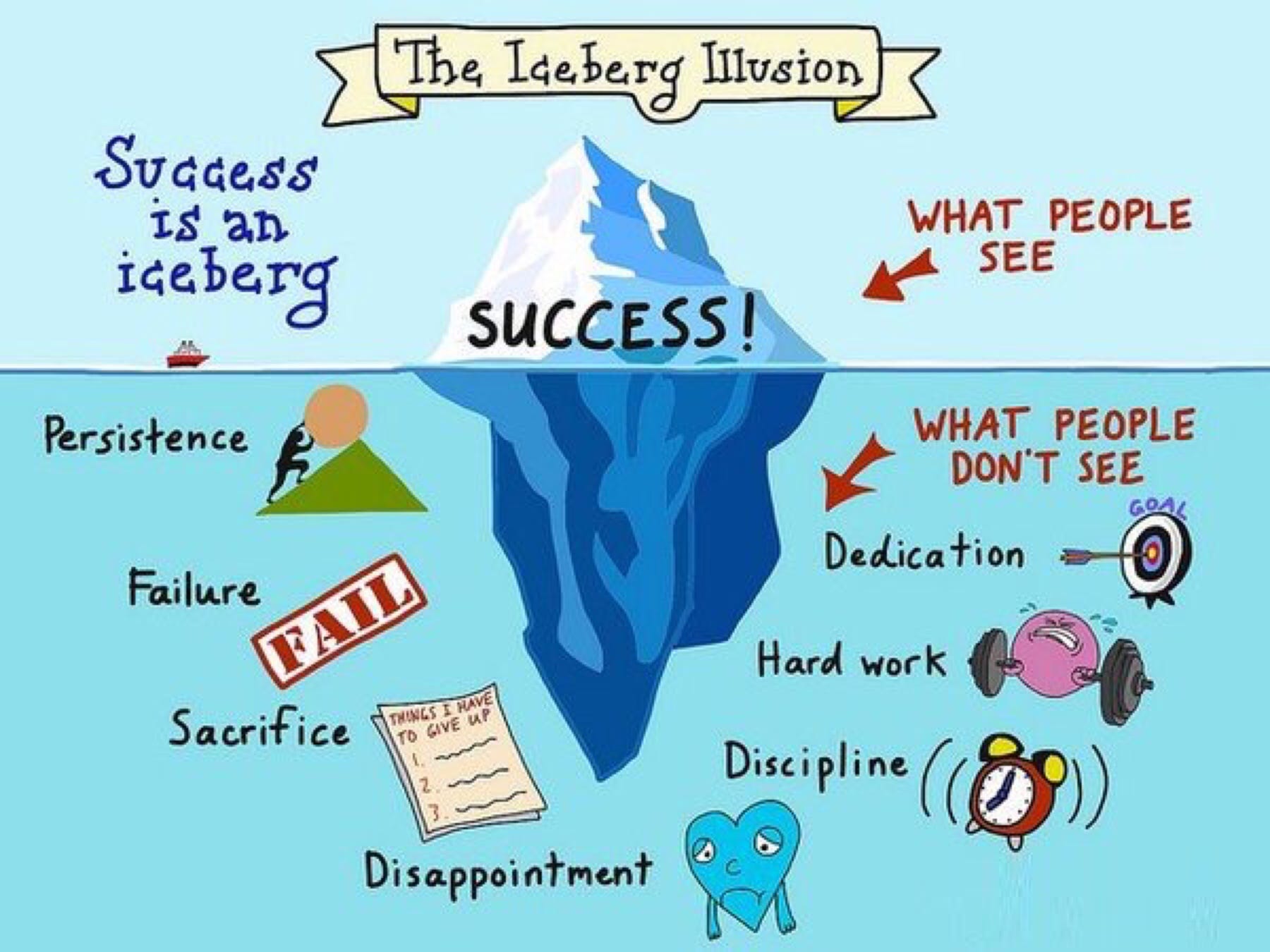
[It seems that rejections are common to everyone, even the highest esteemed scholars get them despite their obvious wisdom and knowledge. My friends shared some good advice and resources that help to bounce back from rejection. First off: upward and onward, as simple as it sounds, it works ... once you have managed to soften the feeling of a work being rejected. The process is to reflect, look at the feedback (or if they did not send any, ask for all the feedback, of course, anonymized), and rewrite and resubmit. Next, a great article in Medium on The Iceberg Illusion, adding the picture here as well.]

But the above two rejections just made me realize once more that I am not a traditional academic and as such, I doubt whether I can ever be part of the whole deal. Maybe this frequency of rejection is simply normal, but at present, I just feel I need to take another leap. Just like I did three times before. Maybe I am not made to gradually move forward? Maybe my thing is just this .... jumping ahead and then working on that 'new' concept until it becomes more mainstream.
[Feedback is an essential first step, next of course is to get going and to know thy self. And to repeat to yourself that critique is not personal, and it can be based on a number of reasons that do not even have to be immediately related to the work you did. In a way, emotion wins over ratio every time, but that does not mean we cannot rationalize after the first emotions have gone.]
Ciska sometimes tells me: "don't wine because you are living off the beaten track, even if you could walk the straight and narrow, you still would roll out your own route to get to the next place". Maybe she is right, but it does not make things easier. Maybe, it is never easy for any of us. Even for those who walk the more traditional roads to achieve a professional space in society. I don't know, but each time I get such a rejection, I just feel it's because of me, and it feels personal.
Okay, time to move forward again. Working on a project which combines human resources, AI and learning... fun, I must admit.
[and this is - and has always been - an inspiring Last Lecture]


Cartoon in this blogpost is from the fabulous Nick D. Kim - the http://www.lab-initio.com/ site

Tuesday, 30 January 2018

Top 10 open access papers from 2017 @nidl_dcu #research #onlinelearning #open

The National Institute for Digital Learning in Dublin (NIDL), Ireland has listed what they see as the top 10 open access articles worth reading in 2017 here (with a small abstract for each). All the top reads are featured in open access journals with high quality criteria. The paper by Perkins and Lowenthal is of interest, as they ranked open access journals. I have the impression open access is (luckily!) still on the rise. Unfortunately, open access papers are rarely seen as a valuable career move for early to experienced researchers.The NIDL launched the top papers one by one through twitter @NIDL_DCU .

Last year one of my co-authored papers with Aras Bozkurt (who was also a top author in the 2017 papers!) and Nilgün Ozdamar Keskin entitled Research Trends in Massive Open Online Course (MOOC) Theses and Dissertations: Surfing the Tsunami Wave was part of the top 10 reads for 2016 (which we only found out just now *blush*). For those wanting to read the full list of 2016 articles, feel free to find them listed here.

These are the 10 publications that NIDL has considered for the 2017 list, although it needs to be stressed that there are many other journal articles worthy of consideration and further evaluation depending on your specific interests:

No. 1: Blended Learning Citation Patterns And Publication Networks Across Seven Worldwide Regions

Authors: Kristian Spring & Charles Graham Journal: Australasian Journal of Educational Technology

No. 2 Review and Content Analysis of International Review of Research in Open and Distance/Distributed Learning (2000–2015)

Authors: Olaf Zawacki-Richte, Uthman Alturki & Ahmed Aldraiweesh
Journal: International Review of Research in Open and Distributed Learning

No. 3 Trends and Patterns in Massive Open Online Courses: Review and Content Analysis of Research on MOOCs (2008-2015)

Authors: Aras Bozkurt, Ela Akgün-Özbek, & Olaf Zawacki-Richter
Journal: International Review of Research in Open and Distributed Learning

No. 4 Theories and Frameworks for Online Education: Seeking an Integrated Model

Author: Anthony G Picciano
Journal: Online Learning Journal 

No. 5 A Critical Review of the Use of Wenger’s Community of Practice (CoP) Theoretical Framework in Online and Blended Learning Research, 2000-2014

Authors: Sedef Uzuner Smith, Suzanne Hayes & Peter Shea
Journal: Online Learning Journal

No. 6 Refining Success and Dropout in Massive Open Online Courses Based on the Intention–behavior Gap

Authors: Maartje A. Henderikx, Karel Kreijns & Marco Kalz
Journal: Distance Education

No. 7 Special Report on the Role of Open Educational Resources in Supporting the Sustainable Development Goal 4: Quality Education Challenges and Opportunities

Author: Rory McGreal
Journal: International Review of Research in Open and Distributed Learning

No. 8 A National Study of Online Learning Leaders in US Higher Education

 Author: Eric Fredericksen
Journal: Online Learning Journal

No. 9 Bot-teachers in Hybrid Massive Open Online Courses (MOOCs): A post-Humanist Experience

Authors: Aras Bozkurt, Whitney Kilgore & Matt Crosslin
Journal: Australasian Journal of Educational Technology

No. 10 Gamifying Education: What is Known, What is Believed and What Remains Uncertain: A Critical Review

Authors: Christo Dichev and Darina Dicheva
Journal: International Journal of Educational Technology in Higher Education

    Great reads, each one of them.

    Thursday, 17 November 2016

    Free mobile learning papers from mLearn2016 conference in Sydney #mLearning #mobile

    This is a great set of mobile learning papers (proceedings available here) written for the 15th mLearn conference that was organised in Sydney, Australia on 24-26 October 2016. The theme chosen for the conference was Mobile Learning Futures – Sustaining Quality Research and Practice in Mobile Learning.
    Sustainability and quality are the keys to mobile learning. Future mobile learning research needs to look beyond technological intervention per se. Instead, it must consider a more ecological approach, in which the conditions under which mobile technology contributes to learning are closely examined. The preconditions for sustainability in mobile learning may be broadly categorized as:
    • Economic (financial considerations)
    • Political (leadership, equity and policy)
    • Social (community engagement)
    • Technical (infrastructure, security, devices, applications) and
    • Pedagogical (teaching and learning).
    This sustainable and broadly societal focus, provides mLearning proceedings that cover a wide variety of impactful mLeanring insights. Issues to consider include teachers‘ technological and pedagogic expertise when evaluating the effects of mobile technology on learning and the achievement of the goals of instruction. The subject matter is an important factor, as are also students‘ attributes, background and age, and their mobile digital literacy. Authentic assessments that provide evidence of learning are needed. Other factors include institutional and expert leadership, the physical environment, resources, professional development, collegiality, and a commitment to mobile learning implementation and policy.

    The papers range from the indigenous use of mobile learning, wearable technologies, eyetracking for gaming, teaching digital citizenship, simulation games, augmented realities, micro-credentials and mobile assisted language learning.

    Table of Contents
    Section I: PAPERS
    Faculty Attitudes towards the Use of Mobile Devices in EFL Teaching in a Saudi Arabian Setting
    Radhi Alshammari, Vicente Chua Reyes Jr and Mitchell Parkes

    The Use of Wearable Technologies in Australian Universities: Examples from Environmental Science, Cognitive and Brain Sciences and Teacher Training
    Victor Alvarez, Matt Bower, Sara de Freitas, Sue Gregory and Bianca de Wit

    Ariane: A Web-Based and Mobile Tool to Guide the Design of Augmented Reality Learning Activities
    Victor Alvarez, Juan Ramón Pérez-Pérez, MPuerto Paule and Sara de Freitas

    Survive with the VUVU on the Vaal: Eyetracking Findings of a User Interface Evaluation of a Mobile Serious Game for Statistics Education
    A. Seugnet Blignaut, Gordon Matthew and Lizanne Fitchat

    Perceived Utility and Feasibility of Wearable Technologies in Higher Education
    Matt Bower, Daniel Sturman, Victor Alvarez

    Nurturing Collaborative Networks of Practice
    Thomas Cochrane and Vickel Narayan

    Location-Based Mobile Learning Games: Motivation for and Engagement with the Learning Process
    Roger Edmonds and Simon Smith

    Investigating Children‘s E-Reading Behaviour and Engagement using iPads in First and Second Grade
    Seyedeh Ghazal Ghalebandi and Noorhidawati Abdullah

    Negotiating Cultural Spaces in an International Mobile and Blended Learning Project
    Charlotte N. Gunawardena, Agnieszka Palalas, Nicole Berezin, Caitlin Legere, Gretchen Kramer and Godwin Amo-Kwao

    Landscape and Literacy on Aboriginal Country
    Olivia Guntarik and Aramiha Harwood

    Using Web 2.0 Tools to Support Student Writing
    Susan Gwee and Shalini Damodaran

    Teaching Digital Citizenship in Higher Education
    Boris Handal, Sandra Lynch, Kevin Watson, Marguerite Maher and Grace Hellyer

    Flipped Learning Approach for a University EFL Course: Utilizing an Online Communication System
    Yasushige Ishikawa, Yasushi Tsubota, Craig Smith, Masayuki Murakami, Mutsumi Kondo, Ayako Suto, Koichi Nishiyama, and Motoki Tsuda

    A Mobile Learning Framework for Developing Educational Games and Its Pilot Study for Secondary Mathematics Education
    Yanguo Jing and Alastair Craig

    Designing an Engaging Healthcare Simulation Game
    Tuulikki Keskitalo and Hanna Vuojärvi

    A Mobile Reader for Language Learners
    Jemma König, Ian Witten and Shaoqun Wu

    Mobile Learning as a Tool for Indigenous Language Revitalization and Sustainability in Canada: Who Will the Pipe Holders Be?
    Marguerite Koole and Kevin wâsakâyâsiw Lewis

    Mobile Learning in Practical-based Subjects: A Developing Country Perspective
    Suzaan Le Roux

    Learning beyond Classroom Walls: A Case Study on Engaging Learners with Mobile Devices in Dance and Drama
    Zihao Li

    Reboot Your Course – From Beta to Better
    Zoe Lynch and Michael Sankey

    A Theory-ology of Mobile Learning: Operationalizing Learning Theories with Mobile Activities
    Kathryn MacCallum and David Parsons

    Responsive Web Design: Experience at the National Distance University of Costa Rica
    Seidy Maroto-Alfaro and Yeudrin Durán-Gutiérrez

    Analysing Student-Generated Digital Explanations
    Wendy Nielsen, Helen Georgiou, Annette Turney and Pauline Jones

    Changing Use of Social Media Tools by Preservice Primary Teachers to Learn Science
    Wendy Nielsen, Amir Rezaaee and Rachel Moll

    Encouraging Faculty Development through Micro-Credentialing
    Lisa O‘Neill

    A Mobile Sensor Activity for Ad-Hoc Groups
    David Parsons, Herbert Thomas, Milla Inkila

    Conserv-AR: A Virtual and Augmented Reality Mobile Game to Enhance Students‘ Awareness of Wildlife Conservation in Western Australia
    Luke Phipps, Victor Alvarez, Sara de Freitas, Kevin Wong, Michael Baker and Justin Pettit

    Bring-Your-Own-Device or Prescribed Mobile Technology? Investigating Student Device Preferences for Mobile Learning
    David Reid and Ekaterina Pechenkina

    How a Blended, M-Learning Approach to Student Evaluations Increases Participation Rates
    Chris Tisdell and Alex Usachev

    Using Cloud Drive for Collaborative Learning in Adult Training
    Hwee Leng Toh-Heng

    A Theory of Enhancement of Professional Learning for Aboriginal and Torres Strait Islander Pre-service Teachers in Very Remote Communities through Mobile Learning
    Philip Townsend

    Enhancing Workplace Learning through Mobile Technology: Barriers and Opportunities to the Use of Mobile Devices on Placement in the Healthcare and Education Fields
    Franziska Trede, Peter Goodyear, Susie Macfarlane, Lina Markauskaite, Celina McEwen and Freny Tayebjee

    Does the Mobility of Mobile Learners across Locations Affect Memory?
    Chrysanthi Tseloudi and Inmaculada Arnedillo-Sánchez

    Let‘s Learn Business Japanese with Learning Log System and E-book
    Noriko Uosaki, Mahiro Kiyota, Kousuke Mouri, Hiroaki Ogata and Chengjiu Yin

    Introducing Mobile Videos for Academic Support
    Mari van Wyk and Linda van Ryneveld

    Learning Official Crisis Communication through Decentralized Simulations enabled by Mobile ICTs
    Hanna Vuojärvi and Tuulikki Keskitalo

    Location-Based Vocabulary Learning App
    Shaoqun Wu, Karun Pammi and Alex Yu

    Learning Collocations with FLAX Apps
    Alex Yu, Shaoqun Wu, Ian Witten and Jemma König

    Factors in Designing an Augmented Reality M-Learning Trail with Place-based Pedagogy in Residential Education
    Kevin K. Yue, Lisa Y. Law, Hiu Ling Chan, Jade B. Chan, Elaine Y. Wong, Theresa F. Kwong and Eva Y. Wong
    Section II: PRACTITIONERS‟ PRESENTATIONS

    Designing Physics Courses to Increase Student Engagement for Online and Mobile Environments
    Elizabeth Angstmann, John Reddin and Matthew Burley

    Building a Campus-Wide Mobile Platform that Focuses on Enhancing Student Effectiveness and Learning
    Matthew Burley, Alexander Roche and John Reddin

    Designing for Mobile Learning
    Lucila Carvalho and Pippa Yeoman

    Lighting a FUSE Program for Student Engagement and Differentiated Learning with Mobile Technologies
    Scott Diamond and Andrew Brown

    Pedagogy GO: Enhancing Educational Experiences with Location-Based Mobile Learning Games
    Roger Edmonds and Simon Smith

    Mobile Learning: An Innovative Approach that Puts the Control of the Internet of Things into the Hands of Primary School Students
    Deborah Evans and Alix Spillane

    Teaching Arabic Alphabet using EBook Widgets
    Hany Fazza

    Integrating iPads into Science Teaching and Learning
    Heidi Hammond and Linda Clutterbuck

    Google Classroom in My Classroom
    Nicole Holgersson

    Sustaining Mobile Learning Pedagogies with High Possibility Classrooms: A Vision for Teacher Education in Australian Universities
    Jane Hunter and Ariane Skapetis

    Why Gamified Learning and Using Games to Teach are not the Same Thing
    Michael Kasumovic

    Using Mobile Serious Games Technology to Enhance Student Engagement and Learning in a Postgraduate Ethics Classroom: A Case Study
    Gillian McGregor and Emma Bartle Our ‗Have a go, Share and eValuate‘

    iPad Learning Journey: From Implementation to Acceptance
    Damien McGuire

    Mobile Phone Potential in Secondary School Classrooms
    Gus McLean

    A Global Classroom: The ACO Music & Art Program
    Vicki Norton and Zoe Arthur

    Accepting the Challenge of Adapting Traditional Faculty Development to Online and Mobile Environments
    Lisa O‘Neill

    How Does a Mobile App Incorporate Facebook-Style Social Connectivity within a Learning Platform?
    Alexander Roche, Josephine Chan, Anthony Chung and Matthew Burley

    How Does a Mobile Platform Address TEQSA and Other Regulatory Compliance for Online Courses?
    Alexander Roche, Josephine Chan, Anthony Chung and Matthew Burley

    Online Tutorials and GeoGebra as Mobile Learning Tools
    Norman J. Wildberger and Joshua Capel

    Monday, 29 February 2016

    eMOOCs2016 proceedings and a call of papers #CfP #MOOC

    The eMOOCs2016 conference in Graz, Austria just finished. Looking at the research and MOOC experiences that were shared, it is clear that MOOCs are beginning to be understood more in-depth. The organizers turned everything into a wonderful experience (feedback from some colleagues, I could not make it this year due to a number of unfortunate reasons).

    The conference proceedings (which can be downloaded here) are a wonderful, inspiring read for anyone with an interest in MOOCs, either as a researcher or as a practitioner. Just adding a few examples of what you can find in the papers:


    • Learning in MOOCs: A Comparison Study by Colin Milligan, Allison Littlejohn & Nina Hood 
    • Exploring learning objectives at scale through concept mapping of MOOC learner discussions by Silvia Elena Gallagher & Timothy Savage 
    • A Conceptual Business Model for MOOCs Sustainability in Higher Education by Nor Fadzleen Sa Don, Rose Alinda Alias & Naoki Ohshima
    • eMOOCs for Personalised Online Learning: A Diversity Perspective by Tanja Jadin & Martina Gaisch 
    • Driving Learner Engagement and Completion within MOOCs: A Case for Structured Learning Support by Syed Munib Hadi & Rebecca Rawson
    • How to integrate and automatically issue Open Badges in MOOC platforms by Mario Wüster & Martin Ebner “Clinical Supervision with Confidence”: 
    • Exploring the potential of MOOCs for faculty development by Veena Rodrigues & Sam Leinster 
    • Bringing together MOOCs and e-books: theoretical considerations and a concrete educational scenario by Michael Raunig & Elke Lackner 
    • Distributed teaching: Engaging learners in MOOCs by Ann-Kathrin Watolla 
    • Interactive activities: the key to learning programming with MOOCs by Carlos Alario-Hoyos, Carlos Delgado Kloos, Iria Estévez-Ayres, Carmen Fernández-Panadero, Jorge Blasco, Sergio Pastrana, Guillero Suárez-Tangil & Julio Villena-Román
    • MOOCS as an Opportunity to Foster International Collaboration between Universities: MOOCs for Teachers by Paola Corti, Manuela Milani & Susanna Sancassani

    In addition to the conference proceedings, there is also a call for papers for a special issue focus on Open Education (for the journal of computing in higher education) from the eMOOCs2016. The full call can be found here. A brief description is added below:

    Special issue focus Open Education is currently at the crossroads of becoming either an integral part of the higher education landscape or a sellout for venture-capital driven companies who use openness as a means to increase their customer base. At the same time research on open education is developing into two different directions, namely open educational resources (OER) and open educational practices (OEP). For both directions, an underlying vision is formulated to increase accessibility to (higher) education on a global scale. While OER research has focused for a long time on production and publication of learning resources under open licenses, little attention has been given to actual research about adaptation and embedding of OER in new contexts including psycho-social factors influencing OER reuse. For MOOCs and open courses, the most prominent research challenges are related to scalability of feedback and support, educational design of open courses, and also on the integration of new technologies into open learning environments. These challenges also lead to many unresolved questions about interfaces between formal and informal learning, certification and recognition, and also the wider societal responsibilities for higher education. This special issue titled “Advancing Research on Open Education” will focus on empirical research dealing with the advancement of the field of open education for postsecondary and adult learners.