Friday, 9 June 2017

#OEB_midsummit Surviving Digital Darwinism Tony Driscoll @wadatripp #corporate


Tony Driscoll – with nicely trimmed beard and liking jeans – takes the stage and starts with a bit of personal history, and how teaching was in his generational history. Full slide deck can be found below (fab drawings to support the message)

Why the future does not need us’ was an article that changed Tony’s life. He realized then that he was a techno positivist, but what would happen when something does not turn out positively, what really goes on in this intersection with technology. What will the technological effect be for current children, and what can we do in order to make them ready for the future.
Time is always part of the derivative for the rate of change, and distance and jerk. We know what velocity is, acceleration, but we do not know what jerk is (acceleration over time). Technology is currently jerking humanity around. So, the humans built a tech neural system that absorbs humans and defines how we interact and are connected. We – the humans – need to process more now than ever before, and our minds can no longer keep on top of this. The speed of life is increased, where wave upon wave of disruption by tech is coming and humans are not equipped for this. We have an inability to see catastrophy coming. For kids of today the tech disruptiveness will be even higher than in our lifetime, or the lifetime of our grandparents.
Business value progression and structural lag: so companies are catching up to create value in the market space. If the rate of change on the outside exceeds the rate of change on the inside the end is near – Jack Welch. The average age of companies is now 18 years, and it is decreasing.
Leveraging technology to achieve active and instant reactions.
Tony’s fear is that he and his sons is flying into a jerk hole.
Scenario’s:
Positive scenario: technology does not have a conscious, it just accelerates human fulfillment, the fly wheel of tech synchronise to open new frontiers for everybody. Empowerment for everyone, and all humans can live a happy life. But hope is not a strategy.
Enslaved scenario: tech limits the fulfillment in human identity. We reduce human dreams to fit the current form of the tech options. Always go to the always on answer box: google. At highest level it dums us down to IT laborers so we are back to a digital enslaving scenario.
Enmeshed scenario: post-human: implants, living longer, downloading emotions into a virtual environment to live longer or forever. But question is will this life be fulfilled, and are we willing to give up our unique human identity.
Worst scenario: extinguished: tech accelerates to a point where humans are no longer here. Tech is the next evolution.
But how can we prepare our kids for either the enslaved or the enmeshed trajectory.
Learning from experience: a story about a lost colony is shared with humor (uses superposition of old and new society) and at the end a question, resulting in the message: we need to unlearn and we must change learning.
We need to train people to figure it out (generative learning), collaborative learning, authentic learning, doing and learning, virtual ecologies, learner centered… quoting Jay Cross: optimizing our networks (internet and human).
[Inge, he uses a personal storyline to bring across a message that can be delivered in a multitude of options]

#OEB_midsummit Audrey Watters on personalization & pigeons


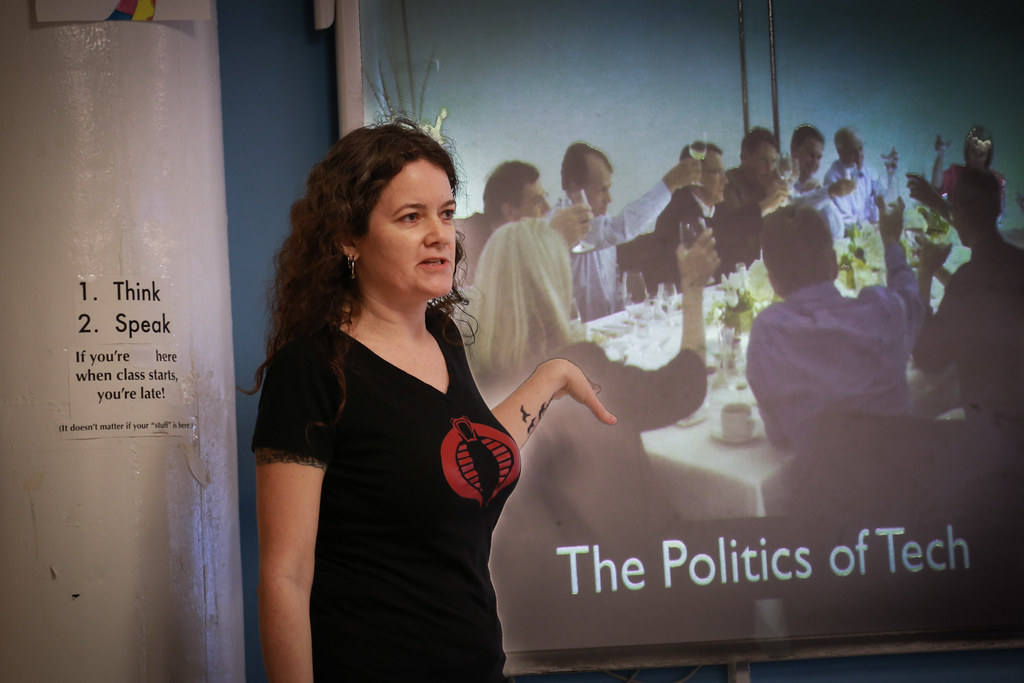
Image result for audrey watters Very excited to see Audrey Watters in action in real life after having read her posts and keynotes on many occasion where my mind was in need of critical analysis of contemporary learning and society. She is wearing some fabulous boots (!) and looks fierce as ever.
There is no agreed upon definition of personalized learning. There is a history of people working in tech, she refers to disruptive narrative often accompanying the technological discourse. The invention of education is filled with slogans, imagined histories… and they add to the narrative of Edtech and its perceived disruption.
Currently, there is a hype towards the need for personalized learning. This could mean that students to move through content at their own pace. Or personalized learning could mean that the students get to determine the topics. Or it could mean that it is personalized by students visions, ideas. It can be driven by student needs or abilities, navigating through education. Or personalized learning will only be attained through computer technologies, through automation of everything, the tech being the salvation.
The history is filled with traceable legacies on what education is, and this points towards your philosophical and political (and economic) views/values.
The latest influence of ‘philantropics’ putting their money in one type of definition of personalized learning, has a profound impact on education.
The definition of personalized learning today is related to 1903, individual learning can be traced back to 18th century. This shows that personalized learning is a very recent development where the individual learning was replaced in personalized learning.
‘rugged individualism’ is a core American ideology, particularly Sillicon Valley (back to frontier days). This is also deeply intertwined with contemporary capitalism. Post-war consumer capitalism. Personalisation acts as a salve for standardization, in an age of mass consumption (name on coke bottle to make it feel special). Personalisation is related to customization, more than actual tailored to the person’s own needs.
So, how much of personalization is this contemporary definition: think MOOC, think online courses, online tech, … we even have the ‘personal’ computer (oh, I like this parallel and critical realization).
Pressey (name not sure) made an automated teacher, and wrote a practical guide on standardized testing. By the 1920’s standardization was already embedded in the American educational system.
The message that automation is going to free the teacher is also very perverse. It is not about labor saving devices. The automated teacher was seen as a need for personalization, but it was in fact a response on standardization.  
Self-management, self-help has got…
[suddenly Audrey completely lights up when she mentions the link between pigeons and education, and that she could go on for hours on this link… it reminds me of my grandfather who had pigeons that entered competitions – blauwe geschelpte his type of pigeons were called].
All the smart people fucked up education, and no one takes responsibility. There is currently a death of expertise, this has an impact on the future of education, of society. How does an algorithmically driven FB news impacts ‘the news’.
Freedom of the state is the cost of education being supported by private money. Schools suddenly need to use the buzzword personalization, but there is no government oversight, and no appeal to civil and human rights in the face of the shift of personalized learning. In democracies one can wonder whether we can maintain shared responsivities for collective justice when our institutes are taken down.

Thursday, 8 June 2017

#OEB_midsummit Andrew Keen on How to fix the future @ajkeen #AI


Andrew wears his casual black attire and looks energetic and ready to roll with seeming ease and humor. And right before taking the stage, Andrew put on his jacket (I like that personal touch).

Thinking is about talking, entering into dialogue and getting messages across and combined by people. It is not about the slides.
We have education, but in the end everyone says: the solution is education, everything can be fixed by education. But the education system is inseparable of the economic, social problems of society. A teacher alone cannot fix inequation and other difficulties of society.
Education can only do so much, but it cannot change rampant mass murder (history is full of that). Education is not magic, it is work.
The great transformations have always been part of revolutions in history. But this transformation is taking us into new realms, but transformations have always happened. But change brings along trauma in many cases.
Andrew Keen mentions groups for which the societal transformation did not work, dramatic inequality and revolution. (this is an ethical take based on moral right and wrong as perceived by Andrew). Equality only came gradually, and we are not really there yet.
Surveillance economy coming from innovations at Silicon Valley, similar to the industrialists during the industrial revolution. Unions, taxes… came later to right the wrongs of that transformation. The same might be coming now. Education was than instituted as a form of standardization for production reasons (same skills, same content, same books…).
Today the forces are similar, how are we supposed to educate people for this new world.
The ideology of Silicon valley is increasingly being applied to education (see NYTimes of 7 June 2017 – silicon valley billionaires and schools). Zuckerberg empowers the student, but undermines the teacher. Undermining truth (e.g. fake news). Hastings (Netflix) is a different type of influencing Education, in his term by using Artificial Intelligence that will improve the teaching by providing tools. Bennihof (?) importing the sillicon valley business approach into schools, treating education as a venture capitalist adventure. But it is important to realise that the state is being pushed aside, replaced by super-citizen billionaire vision. So, this is never about technology, it is always about who has the power, who has the money. Make AI the operating system for this new teaching/learning system.
[this is possibly – I think – when implementing policies based on future goals].
What jobs are we going to have in a world where AI dominate the classroom, the law firm, the university… the hole in the future is jobs. Be wary that the educational nirvana by AI will not be without a cost. We have not seen anything yet, when 50% of us no longer have jobs due to AI and automation. Let’s not go overboard. STEM is no longer interesting, as machines can do this much more efficiently. So tech education has no real value. So what should we be educating people for? That is the great challenge, and that is why education is in the middle of a transformation. As we create machines and AI, what are we going to do? Are we going to be poets, fighters, share thoughts from the coach… what is going to be our ‘value’ in this new economy? Machines can do many things, but they cannot think for themselves, and they do not have their own goals.
We should be focusing on human values and skills: empathy, intuition, creativity, … some experimental schools. If you want to escape the algorithm, you need to think and prepare, and be willing to take risks. In 100 years’ time, schools will be different.