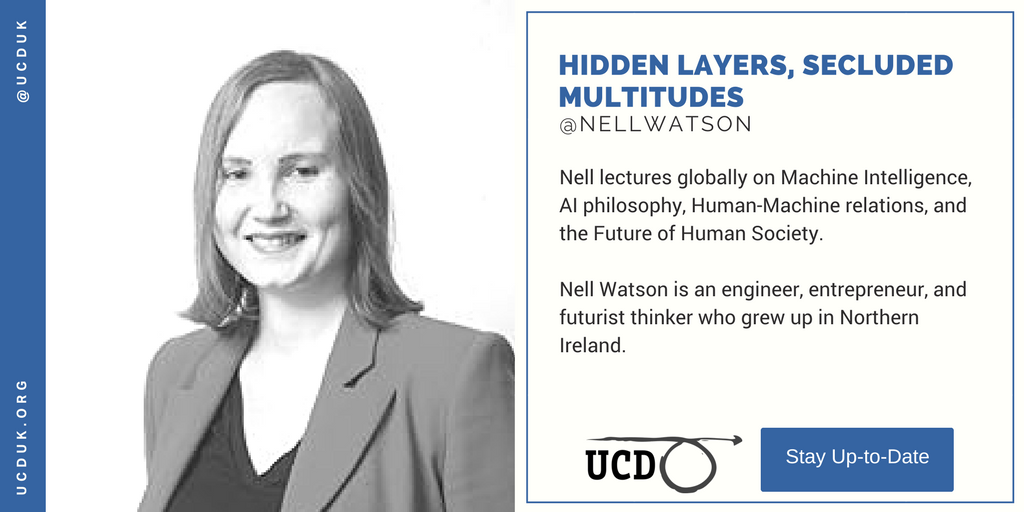
Nell Watson spoke in her natural, slow paced way, bringing her message across in a steady, transparent voice.
Essentially
any task a human brain can do in roughly one second processing time can now by
replicated by a machine. Machines can recognise people, transcribe between
languages, esthetic interpretation, make predictions. What we have today is
something of a revolution, leading us towards intuitive intelligence is a force
moving us to the next revolution. Increasing human intelligence, as most
geniuses are alive today. We never had so many powerful brains with enormous
outputs. The trouble is that the children that are entering the school today,
65 % will take up jobs that will not even exist today. So, how can we prepare
our children. Certainly we can learn, but instead of chosing a role like a job,
the children will have to learn from their strengths and skills to solve
challenges or problems. We are moving towards the 3 c’s critical thinking,
collaboration, complex problem solving. Scratch is an amazing tool, and one
million projects are built and shared every single month. These tools can pluck
together different ideas and make them real, it provides new insights by becoming
a maker. It is also about sharing new ideas, it is like creating a gift, and
see others remix it. Originality is overrated, as remixing is one of the
greatest skills of this new age. To amplify and improve these skills are
essential to help people to grow from each other and let objects grow.
Creativity
and fantasy are essential for growth, the capacity for fantasy can help with machine
learning and learning from machines. Any kind of creativity, can now be turned
into something recognizable by machines [inge:
why would you want this to happen?]
Machine
intelligence helps to create new layers (cfr augmentation). Real time mash-ups
between fantasy are resulting in new creativity [Inge: but examples are known
things turned into other known things, so how is this interesting]. There are
algorithms that can fill in the gaps in knowledge (like finding the dates of a
specific photograph). This leads to further thoughts of children [Inge: but why
would a child want a machine to tell it, how her or his drawing would be
better, how does this promote fantasy?].
Machine
learning can be a mediator between humans: machines can help to create a
persuasive message: empathy is now growing in machine learning [Inge: wondering
whether this is personal profile diversity organized?]. Staff empathy is the
most searched for quality in communication.
Teaching
children moral agency is important. Questioning assumptions in society.
There will
be more and more machine learning entering all of our lives: elderly relatives
helped by enhanced pets – robocat by mattel. But sometimes such research are
spooky, like finding vulnerable children to turn them into consumers feeling
better by materials for instance.
Machine
driven panopticon becomes a reality. Now 3D sensors are embedded in smartphones
to scan and understand the world and merge them together. It is now able to
scan an object, analyse it and to put it back into reality again (shows funny
cat movie).
Good stuff:
text transformed into sign language. Or impactvision, looking inside fruit to
see if fruit is ok. Same for health: looking into the body with smartphones
(e.g. Koen Kas). Or making the heartbeat visible to the naked eye. Looking at
fotos we can find gene combinations, or finding stress in animals and humans.
Machines
can help to unbundle our own personal complexity, which we not seem to be able
to do.
Intelligence
is going to be embedded everywhere. Machines are helping us to ‘how best to
spend our money’, so machines are already supporting and advising us in certain
ways. Replika is a machine, and research shows that humans do not care talking
to machines. One example is a dead person turned into AI, enabling the partner
to talk to their dead partner after dead.
In some of
our imagination we need to destroy the bots, but in truth we find that we can
outgrow our human shyness as humans. The more we get familiar with machine
learning, we become more open in opening up to machines in our lives, embedding
them in our lives. There is of course the good and the bad. We cannot help to
put on ‘personhood’ onto those robots. So if an identity is felt, we cannot
help to anthropomorphize quit robots. Brains scans show humans feel for robots
(shows movie with robot being hurt). Our species have sit around campfires,
sharing stories… we are driven to connect with others, it is an intrinsic part
of being humans. We are bound to connect with humans and non-humans. USC institute for creative technologiesmultisense and simvoice interaction.
We are
entering a world where the humans build sensitive relationships with machines.
Technologies will make scarce things abundant (e.g. to respond to loneliness).
But we need to learn from the lessons of the past.
AI needs
good influences and great role models. AI is growing up and is shaping the
nature of humanity. Computational ethics or machine ethics, letting machines
OpenEth.org,
helping to map ethics and explore dilemma’s [Inge look this up]. Nell thinks
that non-fiction is for facts, and fiction is for values.
3 billion
machines will come online within before 2020… and it will increase
exponentially. We want to make it easy, working on scratch for ethics which
uses emoji’s to help people link together ethics to emotions. Nell believes in
the kindness era, if only we can come together collaboratively, building a
human heart for machines.
 Harold Bekkering reminds me of some of my Dutch family, funny feeling. Once he took the stage, it really was like listening to cousin Folkert.

 Ben Nelson